.svg)

Stop Letting Your Best Roofing Leads Fall Through the Cracks
.webp)
Why Abandoned Calls Management for Roofing Companies Is a Six-Figure Problem You Can't Ignore
Abandoned calls management for roofing companies is the process of capturing, tracking, and following up on every inbound call that goes unanswered — before that lead calls your competitor instead.
Here's how to stop losing roofing leads to abandoned calls:
1. Answer every call within 5 minutes — conversion rates drop by over 80% after 30 minutes
2. Set up Missed Call Text Back (MCTB) — automatically sends an SMS when a call goes unanswered
3. Deploy an AI phone agent — handles after-hours and overflow calls 24/7
4. Use intelligent call routing — directs calls to the right person based on time, availability, and call type
5. Integrate with your CRM — log every lead automatically so nothing falls through the cracks
6. Track your miss rate — identify when and why calls go unanswered so you can fix the gaps
Picture this: a homeowner's ceiling is dripping at 9 PM on a Tuesday. Their roof is failing, and they're in problem-solving mode. They call three roofing companies. Two go to voicemail. One picks up, books a morning inspection, and walks away with a $12,000 job.
That's not a lucky break for your competitor. That's what happens every single day when roofing companies miss calls.
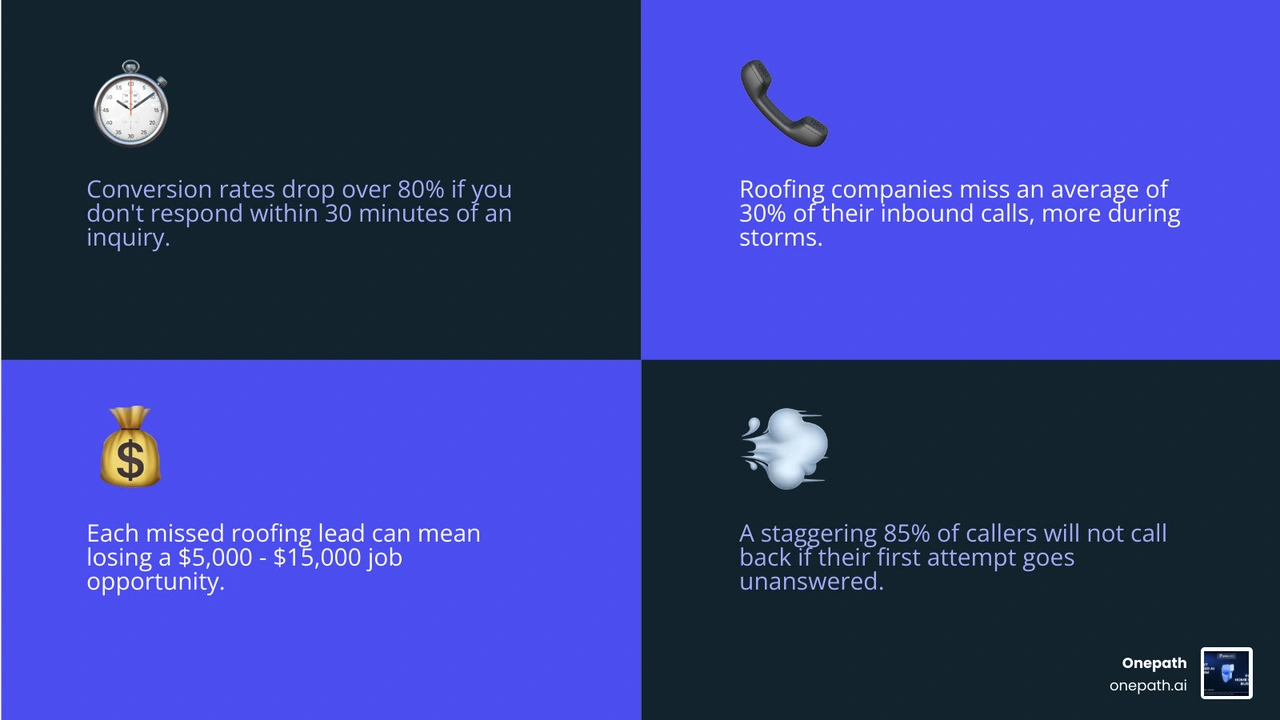
Roofing companies miss roughly 30% of their inbound calls on average — and that number climbs sharply during storm season when call volume can surge by 200–300% or more. With the average residential roofing job worth between $5,000 and $15,000, a handful of missed calls each week adds up to a staggering revenue leak. And here's the part that stings most: 85% of callers who don't get an answer on their first try won't call back. They move on to whoever picks up next.
This isn't a staffing problem or a bad luck problem. For most roofing businesses, it's a structural problem — crews are on rooftops, the owner is running estimates, and no system exists to catch the calls that slip through. The good news is that it's entirely fixable.
Similar topics to abandoned calls management for roofing companies:
• Missed call management software
• Automated abandoned call recovery
The Financial Impact of Missed Opportunities
When we talk about missed calls in the roofing industry, we aren't just talking about a minor administrative hiccup. We are talking about the lifeblood of your business. In our experience, many roofing owners focus heavily on "getting more leads" through expensive ads, but they rarely look at the "leaky bucket" in their own office.
The reality is that phone calls remain the primary way homeowners reach out when they have an urgent roofing need. Whether it's a leak after a spring downpour or visible shingle damage after a hail event, homeowners are in a high-stress, high-urgency mindset. If you don't answer, they don't wait. They simply click the next "Call" button on Google.
Research shows that 85% of customers who don't receive an answer on their first call will not call back. Even worse, 80% of callers will not leave a voicemail. To them, a voicemail is a black hole where help goes to die. They want reassurance that a professional is coming to help now. When you miss that call, you aren't just losing a conversation; you're handing a contract worth thousands of dollars to your competitor.
Effective Abandoned Calls Management is the difference between a business that struggles to find work and one that scales effortlessly by capturing the leads it's already paying for.
Quantifying Revenue Loss from Abandoned Calls Management for Roofing Companies
Let's look at the hard math. If your average roof replacement is worth $10,000 and you convert 25% of your leads into sales, every single qualified lead that calls your office is worth $2,500 in potential revenue.
Now, consider that roofing companies miss an average of 30% of their calls. If you receive 40 calls a week and miss 12 of them, you are potentially watching $30,000 in weekly revenue evaporate. Over a year, that is a seven-figure revenue leak.
But the cost goes deeper than just the immediate contract:
• Lifetime Customer Value (LCV): A happy roofing customer provides future repairs, gutter work, and eventually another replacement decades down the line.
• Referral Loss: In roofing, referral leads close at 60–70% — which is 3–5x better than any paid channel. When you miss a call, you lose the referrals that customer would have sent your way.
• Wasted Marketing ROI: If you are paying $50 to $150 per lead through Google Local Services Ads or SEO, every Abandoned Call represents direct marketing dollars thrown in the trash.
Why Roofing Leads Abandon Calls and How to Stop It
To solve the problem, we have to understand the psychology of the caller. Homeowners rarely call a roofer because they're bored; they call because they are worried. Their home is likely their most valuable asset, and a compromised roof is a threat to that asset.
When a call goes to voicemail or rings indefinitely, the homeowner experiences a "fear of neglect." They assume that if you can't even answer the phone to take their money, you certainly won't be responsive when there's an issue with the installation or a warranty claim. This perception of unprofessionalism is a brand-killer.
To stop this abandonment, you need to provide an immediate "hook" that stops them from calling the next company. You can find more details on this in our Abandoned Calls Complete Guide.
Solving the Structural Problem of Abandoned Calls Management for Roofing Companies
Roofing is a unique beast. Unlike a retail store, your team is often 40 feet in the air, wearing fall protection, and operating noisy machinery. You can't exactly take a sales call while finishing a ridge cap.
Furthermore, roofing demand is rarely steady. It's often dictated by the weather. A single hailstorm can cause call volumes to spike by 300% in 48 hours. No traditional office staff can handle that surge without help.
• Response Speed — Live Answering Service: 30–60 seconds — Automated AI Recovery (Onepath): Instant (under 5 seconds)
• Availability — Live Answering Service: Usually 24/7 — Automated AI Recovery (Onepath): 24/7/365
• Cost — Live Answering Service: Per-minute (gets expensive in storm season) — Automated AI Recovery (Onepath): Flat-rate or low per-call
• Knowledge — Live Answering Service: Basic scripts — Automated AI Recovery (Onepath): Deeply trained on your services/FAQs
• Outcome — Live Answering Service: Takes a message — Automated AI Recovery (Onepath): Books appointments & qualifies leads
The key to abandoned calls management for roofing companies is moving away from manual "catch-as-catch-can" answering and toward a system that works even when you're on a roof.
Implementing a "No-Missed-Lead" System
Creating a "no-missed-lead" culture starts with systems, not just effort. We recommend a multi-layered approach to ensure that every ring represents an opportunity captured.
First, establish a Lead Response Playbook. This defines exactly who is responsible for calls during business hours and who handles the "overflow" when the lines are busy. But even the best team needs a safety net.
Second, implement Accountability Measures. If you can't measure it, you can't manage it. You need to know your "Missed Call Rate." If you see that 40% of your missed calls happen between 6 PM and 9 PM, you know you have a gap in your after-hours coverage.
For a deeper dive into these systems, see our guide on Automated Abandoned Call Recovery.
Leveraging AI and Missed Call Text Back (MCTB)
The most impactful technology we’ve seen for roofers in April 2026 is Missed Call Text Back (MCTB). It’s simple but incredibly effective. The moment a call goes unanswered, our system triggers an automated, personalized SMS:
"This is [Your Name] from [Your Roofing Co]. I’m on a job site and couldn’t get to the phone. Do you need an emergency repair or a free estimate?"
This text does two things:
1. It stops the search. The homeowner feels heard and is much less likely to call the next roofer on the list.
2. It switches the medium. Homeowners often prefer texting, especially if they want to send you a photo of the leak or damage for a quick assessment.
Beyond simple texting, AI-powered agents can now handle the entire intake process. They can ask qualifying questions (e.g., "How old is the roof?", "Is this an insurance claim?"), check your service area, and even book an inspection directly onto your calendar. This is the gold standard for Abandoned Calls Management Software.
Advanced Abandoned Calls Management for Roofing Companies
Once you have the basics down, it’s time to get sophisticated. Advanced abandoned calls management for roofing companies involves integrating your phone system directly with your CRM.
When a call is missed, it shouldn't just be a notification on your phone. It should be a new "Lead" entry in your CRM, tagged with the marketing source (like "Google Ads" or "Facebook"). This allows you to see exactly which ad campaigns are driving calls that you are failing to answer, helping you optimize your marketing spend.
For more industry-specific tips, check out our Abandoned Calls Management Home Services Guide.
Capturing After-Hours and Peak Demand Leads
Did you know that up to 40% of roofing inquiries occur outside normal business hours? Homeowners often wait until they get home from work or until the weekend to deal with their roofing projects. If your office closes at 5 PM on Friday and doesn't reopen until Monday, you are missing the most active window for residential leads.
To capture these, we use:
• Automated Triage: Sorting emergency leaks from general estimate requests so you only get woken up for the high-priority jobs.
• Two-Way Messaging: Letting customers text your business line so you can respond between meetings or while traveling between job sites.
• Storm Response Mode: A specific "high-volume" call flow that activates during weather events to ensure every frantic homeowner gets an immediate response.
Essential Lead Capture Features for Roofers:
• Instant Trigger: MCTB must fire within 30 seconds to be effective.
• CRM Sync: No manual data entry; leads should flow directly into your sales pipeline.
• Service Area Filtering: Automatically tell callers if they are outside your territory to save your team time.
• Appointment Booking: Integration with tools like Google Calendar or Housecall Pro.
Frequently Asked Questions about Roofing Lead Management
How quickly must I respond to a roofing lead in 2026?
In 2026, "fast" isn't enough; you need to be "instant." Leads contacted within 5 minutes of their inquiry are 21 times more likely to convert than those contacted after 30 minutes. In the roofing world, homeowners often call three to five contractors in a row. If you are the first one to respond — even if it’s just via an automated text — you win the "first-to-answer" advantage, which is the #1 predictor of who gets the job.
Why do 80% of roofing callers refuse to leave a voicemail?
Voicemail feels like a dead end. When a homeowner has a leak, they are in "problem-solving mode." A voicemail doesn't solve their problem; a conversation does. They assume that if you don't answer the phone, you're either too busy to take on new work or you aren't organized enough to handle their project. They would rather spend 30 seconds calling the next person than 30 seconds leaving a message that might never be returned.
Can AI effectively handle complex roofing inquiries?
Yes, but with a caveat. AI is incredible at lead qualification and appointment booking. It can verify if a caller is in your service area, ask about the roof type (metal, shingle, tile), and collect insurance claim info. However, for complex project scoping or emotional homeowners dealing with major storm damage, the AI should be used to "warm up" the lead and schedule a time for your human experts to step in. It’s about using technology to support your team, not replace the personal connection that builds trust.
Conclusion
At Onepath, we know that your biggest roofing lead generation problem isn't getting more leads — it's responding to the ones you already have. Every missed call is a $10,000 opportunity that could be funding your next crew or your next service truck.
Our AI Lead Manager and all-in-one CRM are designed specifically to solve the "structural" problems of the roofing industry. With a 72-hour setup, we can turn your business into a 24/7 lead-capturing machine. We provide full visibility into your customer journey, ensuring that from the first "hello" to the final shingle, no lead ever falls through the cracks.
Don't let your marketing dollars evaporate. Stop losing roofing revenue today and start capturing every opportunity that rings your phone.

Why Abandoned Calls Management for Roofing Companies Is a Six-Figure Problem You Can't Ignore
Abandoned calls management for roofing companies is the process of capturing, tracking, and following up on every inbound call that goes unanswered — before that lead calls your competitor instead.
Here's how to stop losing roofing leads to abandoned calls:
- Answer every call within 5 minutes — conversion rates drop by over 80% after 30 minutes
- Set up Missed Call Text Back (MCTB) — automatically sends an SMS when a call goes unanswered
- Deploy an AI phone agent — handles after-hours and overflow calls 24/7
- Use intelligent call routing — directs calls to the right person based on time, availability, and call type
- Integrate with your CRM — log every lead automatically so nothing falls through the cracks
- Track your miss rate — identify when and why calls go unanswered so you can fix the gaps
Picture this: a homeowner's ceiling is dripping at 9 PM on a Tuesday. Their roof is failing, and they're in problem-solving mode. They call three roofing companies. Two go to voicemail. One picks up, books a morning inspection, and walks away with a $12,000 job.
That's not a lucky break for your competitor. That's what happens every single day when roofing companies miss calls.
Roofing companies miss roughly 30% of their inbound calls on average — and that number climbs sharply during storm season when call volume can surge by 200–300% or more. With the average residential roofing job worth between $5,000 and $15,000, a handful of missed calls each week adds up to a staggering revenue leak. And here's the part that stings most: 85% of callers who don't get an answer on their first try won't call back. They move on to whoever picks up next.
This isn't a staffing problem or a bad luck problem. For most roofing businesses, it's a structural problem — crews are on rooftops, the owner is running estimates, and no system exists to catch the calls that slip through. The good news is that it's entirely fixable.
Similar topics to abandoned calls management for roofing companies:
The Financial Impact of Missed Opportunities
When we talk about missed calls in the roofing industry, we aren't just talking about a minor administrative hiccup. We are talking about the lifeblood of your business. In our experience, many roofing owners focus heavily on "getting more leads" through expensive ads, but they rarely look at the "leaky bucket" in their own office.
The reality is that phone calls remain the primary way homeowners reach out when they have an urgent roofing need. Whether it's a leak after a spring downpour or visible shingle damage after a hail event, homeowners are in a high-stress, high-urgency mindset. If you don't answer, they don't wait. They simply click the next "Call" button on Google.
Research shows that 85% of customers who don't receive an answer on their first call will not call back. Even worse, 80% of callers will not leave a voicemail. To them, a voicemail is a black hole where help goes to die. They want reassurance that a professional is coming to help now. When you miss that call, you aren't just losing a conversation; you're handing a contract worth thousands of dollars to your competitor.
Effective Abandoned Calls Management is the difference between a business that struggles to find work and one that scales effortlessly by capturing the leads it's already paying for.
Quantifying Revenue Loss from Abandoned Calls Management for Roofing Companies
Let's look at the hard math. If your average roof replacement is worth $10,000 and you convert 25% of your leads into sales, every single qualified lead that calls your office is worth $2,500 in potential revenue.
Now, consider that roofing companies miss an average of 30% of their calls. If you receive 40 calls a week and miss 12 of them, you are potentially watching $30,000 in weekly revenue evaporate. Over a year, that is a seven-figure revenue leak.
But the cost goes deeper than just the immediate contract:
- Lifetime Customer Value (LCV): A happy roofing customer provides future repairs, gutter work, and eventually another replacement decades down the line.
- Referral Loss: In roofing, referral leads close at 60–70% — which is 3–5x better than any paid channel. When you miss a call, you lose the referrals that customer would have sent your way.
- Wasted Marketing ROI: If you are paying $50 to $150 per lead through Google Local Services Ads or SEO, every Abandoned Call represents direct marketing dollars thrown in the trash.
Why Roofing Leads Abandon Calls and How to Stop It
To solve the problem, we have to understand the psychology of the caller. Homeowners rarely call a roofer because they're bored; they call because they are worried. Their home is likely their most valuable asset, and a compromised roof is a threat to that asset.
When a call goes to voicemail or rings indefinitely, the homeowner experiences a "fear of neglect." They assume that if you can't even answer the phone to take their money, you certainly won't be responsive when there's an issue with the installation or a warranty claim. This perception of unprofessionalism is a brand-killer.
To stop this abandonment, you need to provide an immediate "hook" that stops them from calling the next company. You can find more details on this in our Abandoned Calls Complete Guide.
Solving the Structural Problem of Abandoned Calls Management for Roofing Companies
Roofing is a unique beast. Unlike a retail store, your team is often 40 feet in the air, wearing fall protection, and operating noisy machinery. You can't exactly take a sales call while finishing a ridge cap.
Furthermore, roofing demand is rarely steady. It's often dictated by the weather. A single hailstorm can cause call volumes to spike by 300% in 48 hours. No traditional office staff can handle that surge without help.
| Feature | Live Answering Service | Automated AI Recovery (Onepath) |
|---|---|---|
| Response Speed | 30–60 seconds | Instant (under 5 seconds) |
| Availability | Usually 24/7 | 24/7/365 |
| Cost | Per-minute (gets expensive in storm season) | Flat-rate or low per-call |
| Knowledge | Basic scripts | Deeply trained on your services/FAQs |
| Outcome | Takes a message | Books appointments & qualifies leads |
The key to abandoned calls management for roofing companies is moving away from manual "catch-as-catch-can" answering and toward a system that works even when you're on a roof.
Implementing a "No-Missed-Lead" System
Creating a "no-missed-lead" culture starts with systems, not just effort. We recommend a multi-layered approach to ensure that every ring represents an opportunity captured.
First, establish a Lead Response Playbook. This defines exactly who is responsible for calls during business hours and who handles the "overflow" when the lines are busy. But even the best team needs a safety net.
Second, implement Accountability Measures. If you can't measure it, you can't manage it. You need to know your "Missed Call Rate." If you see that 40% of your missed calls happen between 6 PM and 9 PM, you know you have a gap in your after-hours coverage.
For a deeper dive into these systems, see our guide on Automated Abandoned Call Recovery.
Leveraging AI and Missed Call Text Back (MCTB)
The most impactful technology we’ve seen for roofers in April 2026 is Missed Call Text Back (MCTB). It’s simple but incredibly effective. The moment a call goes unanswered, our system triggers an automated, personalized SMS:
"This is [Your Name] from [Your Roofing Co]. I’m on a job site and couldn’t get to the phone. Do you need an emergency repair or a free estimate?"
This text does two things:
- It stops the search. The homeowner feels heard and is much less likely to call the next roofer on the list.
- It switches the medium. Homeowners often prefer texting, especially if they want to send you a photo of the leak or damage for a quick assessment.
Beyond simple texting, AI-powered agents can now handle the entire intake process. They can ask qualifying questions (e.g., "How old is the roof?", "Is this an insurance claim?"), check your service area, and even book an inspection directly onto your calendar. This is the gold standard for Abandoned Calls Management Software.
Advanced Abandoned Calls Management for Roofing Companies
Once you have the basics down, it’s time to get sophisticated. Advanced abandoned calls management for roofing companies involves integrating your phone system directly with your CRM.
When a call is missed, it shouldn't just be a notification on your phone. It should be a new "Lead" entry in your CRM, tagged with the marketing source (like "Google Ads" or "Facebook"). This allows you to see exactly which ad campaigns are driving calls that you are failing to answer, helping you optimize your marketing spend.
For more industry-specific tips, check out our Abandoned Calls Management Home Services Guide.
Capturing After-Hours and Peak Demand Leads
Did you know that up to 40% of roofing inquiries occur outside normal business hours? Homeowners often wait until they get home from work or until the weekend to deal with their roofing projects. If your office closes at 5 PM on Friday and doesn't reopen until Monday, you are missing the most active window for residential leads.
To capture these, we use:
- Automated Triage: Sorting emergency leaks from general estimate requests so you only get woken up for the high-priority jobs.
- Two-Way Messaging: Letting customers text your business line so you can respond between meetings or while traveling between job sites.
- Storm Response Mode: A specific "high-volume" call flow that activates during weather events to ensure every frantic homeowner gets an immediate response.
Essential Lead Capture Features for Roofers:
- Instant Trigger: MCTB must fire within 30 seconds to be effective.
- CRM Sync: No manual data entry; leads should flow directly into your sales pipeline.
- Service Area Filtering: Automatically tell callers if they are outside your territory to save your team time.
- Appointment Booking: Integration with tools like Google Calendar or Housecall Pro.
Frequently Asked Questions about Roofing Lead Management
How quickly must I respond to a roofing lead in 2026?
In 2026, "fast" isn't enough; you need to be "instant." Leads contacted within 5 minutes of their inquiry are 21 times more likely to convert than those contacted after 30 minutes. In the roofing world, homeowners often call three to five contractors in a row. If you are the first one to respond — even if it’s just via an automated text — you win the "first-to-answer" advantage, which is the #1 predictor of who gets the job.
Why do 80% of roofing callers refuse to leave a voicemail?
Voicemail feels like a dead end. When a homeowner has a leak, they are in "problem-solving mode." A voicemail doesn't solve their problem; a conversation does. They assume that if you don't answer the phone, you're either too busy to take on new work or you aren't organized enough to handle their project. They would rather spend 30 seconds calling the next person than 30 seconds leaving a message that might never be returned.
Can AI effectively handle complex roofing inquiries?
Yes, but with a caveat. AI is incredible at lead qualification and appointment booking. It can verify if a caller is in your service area, ask about the roof type (metal, shingle, tile), and collect insurance claim info. However, for complex project scoping or emotional homeowners dealing with major storm damage, the AI should be used to "warm up" the lead and schedule a time for your human experts to step in. It’s about using technology to support your team, not replace the personal connection that builds trust.
Conclusion
At Onepath, we know that your biggest roofing lead generation problem isn't getting more leads — it's responding to the ones you already have. Every missed call is a $10,000 opportunity that could be funding your next crew or your next service truck.
Our AI Lead Manager and all-in-one CRM are designed specifically to solve the "structural" problems of the roofing industry. With a 72-hour setup, we can turn your business into a 24/7 lead-capturing machine. We provide full visibility into your customer journey, ensuring that from the first "hello" to the final shingle, no lead ever falls through the cracks.
Don't let your marketing dollars evaporate. Stop losing roofing revenue today and start capturing every opportunity that rings your phone.
Boost Your Lead Conversions. Start Using Onepath Today.
Onepath is your AI Lead Manager, built by tech experts and home service pros. It responds instantly, schedules appointments, personalizes customer interactions, and ensures no lead slips through the cracks—backed by 24/7 human support.
[ Schedule Discovery call ].webp)