.svg)

An Essential Guide to AI Tools to Increase Conversion Rates
.webp)
Why AI Tools to Increase Conversion Rates Are a Game-Changer for Home Service Businesses
The best ai tools to increase conversion rates in 2026 include platforms for intelligent chat, automated A/B testing, behavioral personalization, lead scoring, and dynamic landing page optimization. Here are the top categories to know:
1. Conversational AI and chatbots - Capture and qualify leads 24/7, answering questions instantly
2. AI-powered A/B testing platforms - Automatically generate, test, and deploy winning page variants
3. Behavioral personalization engines - Tailor content and CTAs to each visitor in real time
4. Predictive lead scoring tools - Rank and prioritize leads based on conversion likelihood
5. Dynamic traffic routing tools - Send visitors to the highest-converting page variant automatically
6. AI email marketing platforms - Improve open and click-through rates with smart sequencing
If you run a home service business, you already know the frustration: a potential customer lands on your website, looks around for a few seconds, and disappears. No booking. No call. No lead. Just lost revenue.
The problem isn't always your service or your price. Often, it's the experience — slow responses, generic messaging, and a website that treats every visitor the same regardless of where they came from or what they need.
That's exactly where AI changes the equation. According to research from Boston Consulting Group, AI-driven marketing increases conversion rates by an average of 20%. Companies using AI for personalization report revenue lifts of 10–30%. And businesses deploying AI chatbots for customer support see conversion rates from website visitors climb by as much as 35%.
For a growing home service business juggling leads, scheduling, and customer communication across multiple channels, those numbers aren't just impressive — they're a real path to plugging the leaks in your pipeline without overhauling your entire operation.
This guide breaks down the AI tools that actually move the needle, how they work, and how to choose the right ones for your business.
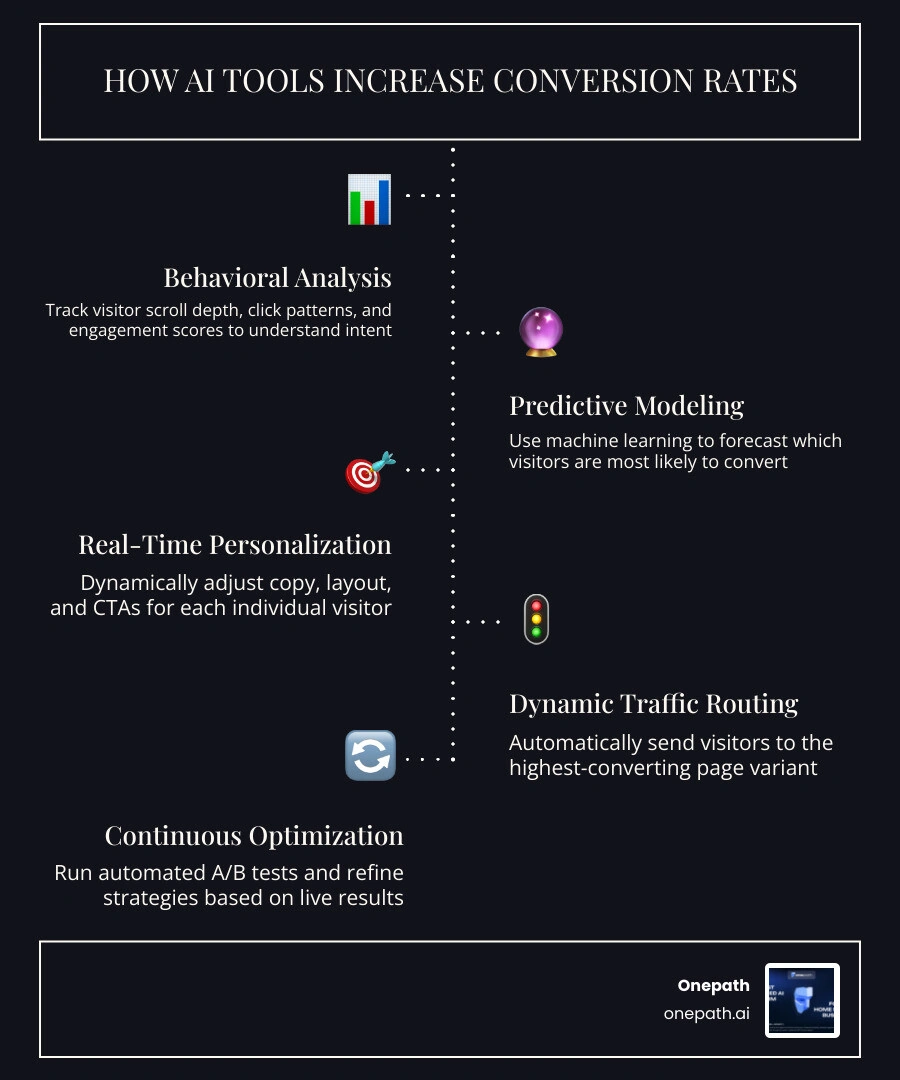
Ai tools to increase conversion rates terminology:
• increase conversion rates for hvac companies
• increase conversion rates for roofing companies
• increase conversion rates for plumbing companies
How AI Tools to Increase Conversion Rates Actually Work
To get the most out of modern conversion rate optimization (CRO), we have to look past the old way of doing things. Traditional optimization relied on slow, manual processes: you came up with a hypothesis, had a designer build a new page, split your traffic 50/50, and waited weeks—sometimes months—to see if your changes made a difference.
AI-powered CRO tools flip this model on its head. Instead of waiting for historical data, artificial intelligence and machine learning algorithms analyze, adapt, and optimize user experiences in real time. They act like a digital detective, spotting invisible patterns in user behavior and adjusting the website on the fly to guide visitors toward booking a service.

At its core, AI conversion software relies on four key pillars:
• Behavioral Analysis: Tracking micro-interactions such as mouse hovers, scroll speed, and click patterns to understand what a user is looking for.
• Predictive Modeling: Using historical data to predict what a visitor is likely to do next and adjusting the page to match their intent.
• Real-Time Personalization: Instantly changing headlines, images, and call-to-action (CTA) buttons based on the user's location, referral source, or past visits.
• Dynamic Traffic Routing: Shifting incoming traffic away from underperforming pages and toward the variations that are actively converting.
Dynamic Traffic Routing and Multi-Armed Bandit Testing
In traditional A/B testing, you split your website traffic evenly between Version A and Version B. If Version B is performing poorly, you continue to send 50% of your valuable traffic to that losing page until the test reaches "statistical significance." That is essentially throwing money away.
AI tools solve this problem using Multi-Armed Bandit (MAB) testing. Instead of keeping a rigid 50/50 split, a multi-armed bandit algorithm continuously monitors your conversions. As soon as it notices one variation starting to outperform the other, it automatically shifts more of your incoming traffic to the winner.
If Version B shows a 15% conversion lift within the first 50 visits, the AI will start routing 70%, then 90%, and eventually 100% of your traffic to that winning version. This dynamic traffic allocation minimizes the negative impact of underperforming pages while maximizing your conversion lift in real time.
Behavioral Analysis and Intent Prediction
Every visitor leaves a digital footprint. How fast do they scroll? Where does their mouse linger? Do they skip past your reviews and go straight to the contact form, or are they carefully reading your guarantees?
AI tools analyze these behaviors to calculate an engagement score and predict user intent. For example, if a visitor scrolls down a page quickly and hovers near the exit button, the AI identifies this "exit intent" and can instantly trigger a behavior-based popup offering a quick booking discount.
By understanding whether a user is a "vibe scroller" (looking at images and reviews) or an "urgency seeker" (looking for an emergency phone number), the AI can dynamically alter the page layout to show them exactly what they need to see to take action.
Key Categories of AI Conversion Software
When building your conversion toolkit, it is helpful to understand how different AI tools address different parts of your marketing funnel. Some tools focus entirely on what happens when a user lands on your site, while others optimize how you nurture those leads once they submit a form.
• Traffic Allocation — Traditional A/B Testing: Fixed 50/50 split — AI-Driven Optimization: Dynamic routing (Multi-Armed Bandit)
• Setup & Maintenance — Traditional A/B Testing: High manual effort, developer dependent — AI-Driven Optimization: Low-code/No-code, automated variants
• Required Traffic — Traditional A/B Testing: High volume needed for significance — AI-Driven Optimization: Low-volume friendly via engagement scoring
• Time to Results — Traditional A/B Testing: Weeks to months — AI-Driven Optimization: Days (often within 10 days)
• Personalization — Traditional A/B Testing: Broad, manual segments — AI-Driven Optimization: Individualized, real-time adaptation
AI Tools to Increase Conversion Rates for Landing Pages
Your landing pages are the digital front door to your business. If you are running paid Google or Facebook ads, sending that expensive traffic to a generic, static homepage is a recipe for high bounce rates.
AI landing page tools allow you to generate dynamic copy, test layout variations, and deploy automated changes without touching a single line of code. For instance, if a visitor clicks an ad for "emergency drain cleaning," the AI can make sure the landing page headline matches that exact phrase, while a visitor searching for "preventative sewer maintenance" sees a completely different layout highlighting long-term service agreements.
To see how specialized landing page strategies can transform local businesses, explore our hands-on guides on how to Increase Conversion Rates for Landscaping Companies and how to Increase Conversion Rates for Moving Companies.
AI Tools to Increase Conversion Rates for Lead Management
Getting a user to fill out a form is only half the battle. Once that lead is captured, the clock starts ticking. If you take hours to respond, that prospect has already called three of your competitors.
AI lead management tools solve this by automating response workflows and using predictive lead scoring. These platforms analyze incoming lead data—such as the services requested, the homeowner's location, and how they interacted with your website—to score the lead's conversion likelihood. High-intent leads are instantly routed to your team for immediate booking, while cooler leads are placed into automated, personalized email and SMS nurture sequences.
To master this process, read our deep dives on AI-Powered Lead Scoring for Home Service Sales and the AI Lead Scoring Home Services Complete Guide.
Conversational AI and Intelligent Chat Assistants
A major bottleneck for home service websites is the lack of 24/7 availability. Homeowners don't just experience plumbing leaks or air conditioning failures during standard business hours; they need help at 11:00 PM on a Sunday.
Conversational AI assistants act as your top digital sales agents. Unlike basic, rule-based chatbots that frustrate users with repetitive, scripted answers, modern intelligent assistants are trained on your specific services, service areas, and brand guidelines. They can answer complex customer inquiries, provide accurate troubleshooting advice, collect contact details, and even book appointments directly into your calendar on autopilot.
Maximizing ROI and Integrating AI into Your Marketing Stack
Investing in ai tools to increase conversion rates can yield massive returns, but only if those tools work together. A scattered tech stack—where your chat tool doesn't talk to your CRM, and your landing page builder is disconnected from your email platform—creates data silos that kill your conversion momentum.
When your systems are fully integrated, the ROI compounding effect is clear:
• Reduced Customer Acquisition Cost (CAC): Converting more of your existing traffic means you get more bookings from the same ad spend.
• Higher Average Order Value (AOV): AI tools can suggest personalized upsells and add-on services right at the moment of booking.
• Faster Booking Cycles: Automating responses and scheduling removes friction, turning casual browsers into scheduled jobs in minutes.
To understand how these conversion principles apply directly to specific home service sectors, check out our comprehensive HVAC Conversion Rates Ultimate Guide and our Roofing Conversion Rates Ultimate Guide.
Overcoming Implementation Challenges and Low Traffic Limits
One of the most common myths is that you need millions of monthly visitors to benefit from AI conversion tools. While high traffic volume certainly helps AI models learn faster, modern platforms have developed workarounds for smaller, local service businesses.
If your site has lower traffic, look for platforms that offer engagement-based testing. Instead of waiting for a completed purchase or booking to declare a test winner, these tools measure micro-conversions like scroll depth, time on site, and clicks on high-value elements (like your phone number or booking button). This allows the AI to determine statistically valid winners with a fraction of the traffic.
Additionally, data privacy is a critical consideration. With strict regulations like GDPR and CCPA, your AI tools must rely primarily on first-party behavioral and contextual signals rather than tracking sensitive personal data. Always choose tools that offer secure integrations and keep visitor data anonymous.
To learn more about optimizing conversion rates for other key service industries, read our guides on Plumbing Conversion Rates Ultimate Guide and the Garage Door Conversion Rates Guide.
Building a Connected Tech Stack for Home Services
For home service businesses in the USA, the ideal setup is a connected CRM and lead management platform that serves as the "brain" of your business. When your AI tools feed directly into a centralized system, you gain full visibility into the entire customer journey—from the first Google search to the final invoice.
Imagine a homeowner searching for flooring or restoration services. They land on your site, chat with an AI assistant, get their questions answered, and book a consultation. Because your AI assistant is integrated with your CRM, the technician arrives at the home already knowing the customer's exact concerns, building instant trust and closing more high-value deals.
To see how a unified stack drives revenue, explore our guides on how to Maximize Revenue for Flooring Companies and our Restoration Companies Conversion Guide 2026.
Frequently Asked Questions about AI Conversion Tools
Do I need high website traffic to benefit from AI CRO tools?
No. While large enterprise sites can run complex multivariate tests quickly, smaller local businesses can leverage engagement-based testing. By measuring scroll depth, click patterns, and chat interactions, AI algorithms can optimize your website layout and messaging with as few as a few hundred visitors per month.
Will AI tools completely replace traditional A/B testing?
AI tools do not replace the need for testing; they automate and accelerate it. Instead of replacing the strategic human element, AI handles the tedious work of generating copy variations, shifting traffic, and deploying winners. Human oversight is still essential for defining brand voice, managing overall strategy, and approving major design changes.
How do AI conversion tools handle data privacy and compliance?
Reputable AI conversion platforms focus strictly on first-party, non-personally identifiable behavioral and contextual signals (such as device type, time of day, and on-page actions). They do not store sensitive personal information, making them fully compliant with modern data privacy regulations like GDPR.
Conclusion
At the end of the day, your website shouldn't just be a digital business card—it should be a 24/7 revenue-generating engine. Implementing the right ai tools to increase conversion rates is the single fastest way to turn your existing website traffic into booked jobs and happy, loyal customers.
At Onepath, we specialize in helping home service businesses across the USA bridge the gap between getting leads and winning customers. Our AI Lead Manager and all-in-one CRM integrates seamlessly with your existing website to instantly respond to incoming leads, automate your scheduling, and personalize your customer interactions across every channel. With our rapid 72-hour setup, full customer journey visibility, and 24/7 human support backup, we make sure that no lead is ever left behind.
Ready to plug the leaks in your sales funnel and grow your business on autopilot?
Transform your lead management with Onepath's AI solutions today!

Why AI Tools to Increase Conversion Rates Are a Game-Changer for Home Service Businesses
The best ai tools to increase conversion rates in 2026 include platforms for intelligent chat, automated A/B testing, behavioral personalization, lead scoring, and dynamic landing page optimization. Here are the top categories to know:
- Conversational AI and chatbots - Capture and qualify leads 24/7, answering questions instantly
- AI-powered A/B testing platforms - Automatically generate, test, and deploy winning page variants
- Behavioral personalization engines - Tailor content and CTAs to each visitor in real time
- Predictive lead scoring tools - Rank and prioritize leads based on conversion likelihood
- Dynamic traffic routing tools - Send visitors to the highest-converting page variant automatically
- AI email marketing platforms - Improve open and click-through rates with smart sequencing
If you run a home service business, you already know the frustration: a potential customer lands on your website, looks around for a few seconds, and disappears. No booking. No call. No lead. Just lost revenue.
The problem isn't always your service or your price. Often, it's the experience — slow responses, generic messaging, and a website that treats every visitor the same regardless of where they came from or what they need.
That's exactly where AI changes the equation. According to research from Boston Consulting Group, AI-driven marketing increases conversion rates by an average of 20%. Companies using AI for personalization report revenue lifts of 10–30%. And businesses deploying AI chatbots for customer support see conversion rates from website visitors climb by as much as 35%.
For a growing home service business juggling leads, scheduling, and customer communication across multiple channels, those numbers aren't just impressive — they're a real path to plugging the leaks in your pipeline without overhauling your entire operation.
This guide breaks down the AI tools that actually move the needle, how they work, and how to choose the right ones for your business.
Ai tools to increase conversion rates terminology:
- increase conversion rates for hvac companies
- increase conversion rates for roofing companies
- increase conversion rates for plumbing companies
How AI Tools to Increase Conversion Rates Actually Work
To get the most out of modern conversion rate optimization (CRO), we have to look past the old way of doing things. Traditional optimization relied on slow, manual processes: you came up with a hypothesis, had a designer build a new page, split your traffic 50/50, and waited weeks—sometimes months—to see if your changes made a difference.
AI-powered CRO tools flip this model on its head. Instead of waiting for historical data, artificial intelligence and machine learning algorithms analyze, adapt, and optimize user experiences in real time. They act like a digital detective, spotting invisible patterns in user behavior and adjusting the website on the fly to guide visitors toward booking a service.
At its core, AI conversion software relies on four key pillars:
- Behavioral Analysis: Tracking micro-interactions such as mouse hovers, scroll speed, and click patterns to understand what a user is looking for.
- Predictive Modeling: Using historical data to predict what a visitor is likely to do next and adjusting the page to match their intent.
- Real-Time Personalization: Instantly changing headlines, images, and call-to-action (CTA) buttons based on the user's location, referral source, or past visits.
- Dynamic Traffic Routing: Shifting incoming traffic away from underperforming pages and toward the variations that are actively converting.
Dynamic Traffic Routing and Multi-Armed Bandit Testing
In traditional A/B testing, you split your website traffic evenly between Version A and Version B. If Version B is performing poorly, you continue to send 50% of your valuable traffic to that losing page until the test reaches "statistical significance." That is essentially throwing money away.
AI tools solve this problem using Multi-Armed Bandit (MAB) testing. Instead of keeping a rigid 50/50 split, a multi-armed bandit algorithm continuously monitors your conversions. As soon as it notices one variation starting to outperform the other, it automatically shifts more of your incoming traffic to the winner.
If Version B shows a 15% conversion lift within the first 50 visits, the AI will start routing 70%, then 90%, and eventually 100% of your traffic to that winning version. This dynamic traffic allocation minimizes the negative impact of underperforming pages while maximizing your conversion lift in real time.
Behavioral Analysis and Intent Prediction
Every visitor leaves a digital footprint. How fast do they scroll? Where does their mouse linger? Do they skip past your reviews and go straight to the contact form, or are they carefully reading your guarantees?
AI tools analyze these behaviors to calculate an engagement score and predict user intent. For example, if a visitor scrolls down a page quickly and hovers near the exit button, the AI identifies this "exit intent" and can instantly trigger a behavior-based popup offering a quick booking discount.
By understanding whether a user is a "vibe scroller" (looking at images and reviews) or an "urgency seeker" (looking for an emergency phone number), the AI can dynamically alter the page layout to show them exactly what they need to see to take action.
Key Categories of AI Conversion Software
When building your conversion toolkit, it is helpful to understand how different AI tools address different parts of your marketing funnel. Some tools focus entirely on what happens when a user lands on your site, while others optimize how you nurture those leads once they submit a form.
| Feature / Capability | Traditional A/B Testing | AI-Driven Optimization |
|---|---|---|
| Traffic Allocation | Fixed 50/50 split | Dynamic routing (Multi-Armed Bandit) |
| Setup & Maintenance | High manual effort, developer dependent | Low-code/No-code, automated variants |
| Required Traffic | High volume needed for significance | Low-volume friendly via engagement scoring |
| Time to Results | Weeks to months | Days (often within 10 days) |
| Personalization | Broad, manual segments | Individualized, real-time adaptation |
AI Tools to Increase Conversion Rates for Landing Pages
Your landing pages are the digital front door to your business. If you are running paid Google or Facebook ads, sending that expensive traffic to a generic, static homepage is a recipe for high bounce rates.
AI landing page tools allow you to generate dynamic copy, test layout variations, and deploy automated changes without touching a single line of code. For instance, if a visitor clicks an ad for "emergency drain cleaning," the AI can make sure the landing page headline matches that exact phrase, while a visitor searching for "preventative sewer maintenance" sees a completely different layout highlighting long-term service agreements.
To see how specialized landing page strategies can transform local businesses, explore our hands-on guides on how to Increase Conversion Rates for Landscaping Companies and how to Increase Conversion Rates for Moving Companies.
AI Tools to Increase Conversion Rates for Lead Management
Getting a user to fill out a form is only half the battle. Once that lead is captured, the clock starts ticking. If you take hours to respond, that prospect has already called three of your competitors.
AI lead management tools solve this by automating response workflows and using predictive lead scoring. These platforms analyze incoming lead data—such as the services requested, the homeowner's location, and how they interacted with your website—to score the lead's conversion likelihood. High-intent leads are instantly routed to your team for immediate booking, while cooler leads are placed into automated, personalized email and SMS nurture sequences.
To master this process, read our deep dives on AI-Powered Lead Scoring for Home Service Sales and the AI Lead Scoring Home Services Complete Guide.
Conversational AI and Intelligent Chat Assistants
A major bottleneck for home service websites is the lack of 24/7 availability. Homeowners don't just experience plumbing leaks or air conditioning failures during standard business hours; they need help at 11:00 PM on a Sunday.
Conversational AI assistants act as your top digital sales agents. Unlike basic, rule-based chatbots that frustrate users with repetitive, scripted answers, modern intelligent assistants are trained on your specific services, service areas, and brand guidelines. They can answer complex customer inquiries, provide accurate troubleshooting advice, collect contact details, and even book appointments directly into your calendar on autopilot.
Maximizing ROI and Integrating AI into Your Marketing Stack
Investing in ai tools to increase conversion rates can yield massive returns, but only if those tools work together. A scattered tech stack—where your chat tool doesn't talk to your CRM, and your landing page builder is disconnected from your email platform—creates data silos that kill your conversion momentum.
When your systems are fully integrated, the ROI compounding effect is clear:
- Reduced Customer Acquisition Cost (CAC): Converting more of your existing traffic means you get more bookings from the same ad spend.
- Higher Average Order Value (AOV): AI tools can suggest personalized upsells and add-on services right at the moment of booking.
- Faster Booking Cycles: Automating responses and scheduling removes friction, turning casual browsers into scheduled jobs in minutes.
To understand how these conversion principles apply directly to specific home service sectors, check out our comprehensive HVAC Conversion Rates Ultimate Guide and our Roofing Conversion Rates Ultimate Guide.
Overcoming Implementation Challenges and Low Traffic Limits
One of the most common myths is that you need millions of monthly visitors to benefit from AI conversion tools. While high traffic volume certainly helps AI models learn faster, modern platforms have developed workarounds for smaller, local service businesses.
If your site has lower traffic, look for platforms that offer engagement-based testing. Instead of waiting for a completed purchase or booking to declare a test winner, these tools measure micro-conversions like scroll depth, time on site, and clicks on high-value elements (like your phone number or booking button). This allows the AI to determine statistically valid winners with a fraction of the traffic.
Additionally, data privacy is a critical consideration. With strict regulations like GDPR and CCPA, your AI tools must rely primarily on first-party behavioral and contextual signals rather than tracking sensitive personal data. Always choose tools that offer secure integrations and keep visitor data anonymous.
To learn more about optimizing conversion rates for other key service industries, read our guides on Plumbing Conversion Rates Ultimate Guide and the Garage Door Conversion Rates Guide.
Building a Connected Tech Stack for Home Services
For home service businesses in the USA, the ideal setup is a connected CRM and lead management platform that serves as the "brain" of your business. When your AI tools feed directly into a centralized system, you gain full visibility into the entire customer journey—from the first Google search to the final invoice.
Imagine a homeowner searching for flooring or restoration services. They land on your site, chat with an AI assistant, get their questions answered, and book a consultation. Because your AI assistant is integrated with your CRM, the technician arrives at the home already knowing the customer's exact concerns, building instant trust and closing more high-value deals.
To see how a unified stack drives revenue, explore our guides on how to Maximize Revenue for Flooring Companies and our Restoration Companies Conversion Guide 2026.
Frequently Asked Questions about AI Conversion Tools
Do I need high website traffic to benefit from AI CRO tools?
No. While large enterprise sites can run complex multivariate tests quickly, smaller local businesses can leverage engagement-based testing. By measuring scroll depth, click patterns, and chat interactions, AI algorithms can optimize your website layout and messaging with as few as a few hundred visitors per month.
Will AI tools completely replace traditional A/B testing?
AI tools do not replace the need for testing; they automate and accelerate it. Instead of replacing the strategic human element, AI handles the tedious work of generating copy variations, shifting traffic, and deploying winners. Human oversight is still essential for defining brand voice, managing overall strategy, and approving major design changes.
How do AI conversion tools handle data privacy and compliance?
Reputable AI conversion platforms focus strictly on first-party, non-personally identifiable behavioral and contextual signals (such as device type, time of day, and on-page actions). They do not store sensitive personal information, making them fully compliant with modern data privacy regulations like GDPR.
Conclusion
At the end of the day, your website shouldn't just be a digital business card—it should be a 24/7 revenue-generating engine. Implementing the right ai tools to increase conversion rates is the single fastest way to turn your existing website traffic into booked jobs and happy, loyal customers.
At Onepath, we specialize in helping home service businesses across the USA bridge the gap between getting leads and winning customers. Our AI Lead Manager and all-in-one CRM integrates seamlessly with your existing website to instantly respond to incoming leads, automate your scheduling, and personalize your customer interactions across every channel. With our rapid 72-hour setup, full customer journey visibility, and 24/7 human support backup, we make sure that no lead is ever left behind.
Ready to plug the leaks in your sales funnel and grow your business on autopilot?
Transform your lead management with Onepath's AI solutions today!
Boost Your Lead Conversions. Start Using Onepath Today.
Onepath is your AI Lead Manager, built by tech experts and home service pros. It responds instantly, schedules appointments, personalizes customer interactions, and ensures no lead slips through the cracks—backed by 24/7 human support.
[ Schedule Discovery call ].webp)