.svg)

Bringing Your Lead Flow Back to Life with Better CRO
.webp)
Why Knowing How to Increase Conversion Rates for Restoration Companies Can Make or Break Your Business
To increase conversion rates for restoration companies, focus on these core actions:
1. Optimize for mobile — most emergency searches happen on phones
2. Add clear, urgent CTAs — buttons like "Request Emergency Cleanup" or "Call Now 24/7"
3. Build instant trust — display IICRC certifications, Google reviews, and before-and-after photos prominently
4. Speed up your site — aim for under 3 seconds load time
5. Simplify your contact forms — 3 to 5 fields maximum
6. Follow up fast — response time is a major factor in whether a lead converts
7. A/B test key pages — small changes to headlines and CTAs can produce significant results
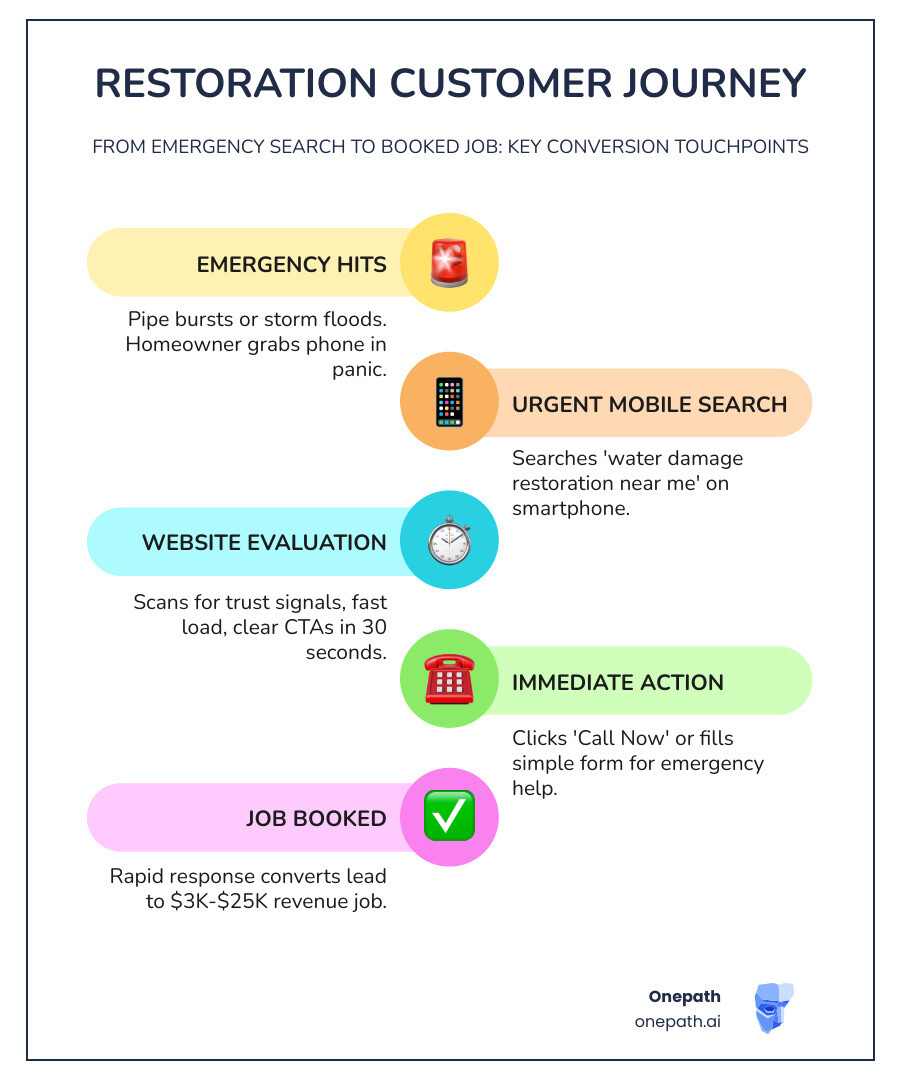
When a pipe bursts at midnight or a storm floods a basement on a Tuesday afternoon, homeowners don't spend days comparing options. They grab their phone, search for help, and call the first company that looks credible. That window — sometimes just 30 seconds — is where restoration businesses win or lose.
The problem is that most restoration companies are very good at the actual work but leave serious money on the table because their websites, follow-up systems, and lead processes aren't built for that moment of urgency. Traffic isn't the issue. Conversion is.
As of April 2026, the gap between restoration companies that convert leads efficiently and those that don't is growing wider. One company saw calls jump from 1,600 to 2,500 in a single year after website optimization. Another tripled revenue from $1.5 million to $4.5 million following a focused conversion overhaul. These aren't outliers — they're the result of fixing the right things in the right order.
This guide walks you through exactly how to do that.
Why You Must increase conversion rates for restoration companies in 2026
In the restoration industry, the "marketing funnel" doesn't look like a slow, traditional journey. For a homeowner standing in three inches of water, the awareness, consideration, and decision phases collapse into mere minutes. This urgency-driven behavior means that if your digital presence doesn't provide an immediate solution, the prospect is gone forever.
High-stakes emergencies require high-performance systems. If you are spending money on Google Ads or Local Services Ads (LSAs), your return on investment (ROI) is directly tied to your conversion rate. For example, in competitive markets, a single click for "emergency water damage restoration" can cost between $20 and $60. If your website fails to convert that visitor, you've essentially thrown that money away. Conversely, a well-managed campaign can see a 4x to 8x return on ad spend because the revenue from a single job—often ranging from $3,000 to over $25,000 for insurance-involved structural drying—is so significant.
Improving your conversion rate isn't just about getting more calls; it's about lead quality. Strategic digital overhauls have been shown to increase ad conversions by 48% while simultaneously reducing the cost per conversion by over 80%. This happens when you Stop Losing Leads by filtering out spam and focusing on high-intent inquiries.
By April 2026, the most successful companies are using AI Lead Scoring for Home Services to prioritize emergency calls instantly. When you understand that up to 50% of potential sales are lost simply due to inadequate information or slow response, the necessity of Conversion Rate Optimization (CRO) becomes clear. It is the engine that turns a $1.5 million business into a $4.5 million powerhouse.
Optimizing Your Digital Storefront for Immediate Action
Your website is the hub of your entire marketing effort. In 2026, it must function as a high-speed emergency room for property damage. If a user arrives and has to hunt for a phone number or wait for a slow video to load, they will bounce back to the search results and click your competitor.
The user experience (UX) should be "frictionless." This means simple navigation, a clean layout, and zero distractions. Avoid "fluff" content on your homepage. Instead, focus on the immediate needs of the customer: "We are here, we are certified, and we can be there in 60 minutes." To truly capture every opportunity, we recommend a Multi-Channel Lead Capture AI that can engage visitors via chat, text, or web forms simultaneously.
Implementing High-Impact CTAs to increase conversion rates for restoration companies
A Call-to-Action (CTA) is more than just a button; it’s a directive. In the restoration world, passive language like "Contact Us" or "Learn More" is too weak. You need action-oriented, urgent language that mirrors the customer’s situation.
Effective restoration CTAs include:
• "Request Emergency Cleanup"
• "Get a Free Mold Inspection"
• "Call Our 24/7 Rapid Response Team"
Placement is just as important as wording. Your primary CTA should be "above the fold" (visible without scrolling) and fixed in the header so it stays with the user as they move down the page. Use high-contrast colors—like a bright red or orange button against a blue or white background—to create a visual hierarchy that draws the eye. When you make it easy to act, you naturally How to Book More Jobs without increasing your ad spend.
Mobile Optimization and Speed as Conversion Drivers
The vast majority of restoration searches occur on smartphones. If your site isn't mobile-responsive, you are essentially invisible to your most desperate customers. Mobile optimization means more than just "fitting" the screen; it means having large, tap-friendly buttons, a simplified menu, and click-to-call functionality that triggers a dialer with one touch.
Speed is the silent killer of conversions. Research shows that websites should aim for a load time of under three seconds. Every second beyond that causes a massive spike in bounce rates. Technical SEO elements, such as minifying code and compressing images, are essential. For contractors who want to stay ahead, using specialized Software for Home Service Contractors AI can help ensure your backend is as fast as your field crew.
Beyond speed, our Instant Lead Response Guide highlights that the "conversion" doesn't end when the user clicks; it ends when a human (or an AI assistant) responds. If your site is fast but your response is slow, the lead will still go elsewhere.
Building Instant Trust Through Social Proof and Authority
Trust is the foundation of the restoration industry. Homeowners are inviting strangers into their most valuable asset during a time of extreme stress. To increase conversion rates for restoration companies, you must provide immediate "proof" that you are the right choice.
The IICRC (Institute of Inspection, Cleaning and Restoration Certification) badge is the single most powerful professional trust signal you can display. It should be prominent on your website, your Google Business Profile, and even your trucks. But certifications are just the start.
Social proof elements that drive the most conversions include:
• Google Reviews: Most customers read an average of 10 reviews before deciding. A high star rating and a high volume of recent reviews are non-negotiable.
• Authentic Visuals: Use real photos of your team, branded vehicles, and equipment. Stock photos of smiling models in hard hats actually decrease trust because they feel "fake" to a person in a real crisis.
• Before-and-After Photos: Nothing demonstrates expertise like seeing a flooded basement returned to pristine condition.
• Empathy-Led Copy: Your text should acknowledge the stress of the situation. Use phrases like, "We understand how overwhelming this is. Our team is here to handle the insurance and the cleanup so you can focus on your family."
For a deeper dive into managing these trust signals, refer to our AI Lead Scoring Home Services Complete Guide, which explains how to use reputation data to further qualify your leads.
Data-Driven Tactics for Long-Term Growth
To move beyond "guessing" what works, you must embrace data. A/B testing (or split testing) allows you to compare two versions of a page to see which performs better. You might test a red "Call Now" button against a green one, or a headline about "Fast Response" against one about "Insurance Expertise."
• Click-to-Call — Typical Conversion Rate: 25-40% — Best Use Case: Emergency water/fire damage
• Short Web Form (3-5 fields) — Typical Conversion Rate: 10-15% — Best Use Case: Mold inspections, rebuild quotes
• Live Chat / AI Agent — Typical Conversion Rate: 20-30% — Best Use Case: After-hours inquiries, general FAQs
• SMS / Text-to-Chat — Typical Conversion Rate: 15-25% — Best Use Case: Quick follow-ups, photo submissions
Addressing objections before they are even raised is another powerful CRO tactic. People often worry about the cost, the insurance process, or how long the drying will take. By including a "How It Works" section or an "Insurance Claims FAQ," you reduce the perceived risk.
Using Automated Lead Management ensures that once a lead overcomes their objections and submits a form, they are nurtured immediately. This is especially important for non-emergency services like mold remediation, where the customer might take a few days to decide. Consistent Lead Nurturing for Contractors AI keeps your brand top-of-mind.
Advanced Strategies to increase conversion rates for restoration companies
Once your website foundation is solid, you can implement advanced tactics. Personalized messaging, where your ads and landing pages specifically mention the user's city or the specific type of damage they searched for, can significantly boost relevance.
Retargeting ads are also vital. If someone visits your mold remediation page but doesn't book, a retargeting ad on social media can offer an incentive, like a "Free On-Site Assessment," to bring them back. Furthermore, leveraging AI-Powered Lead Scoring Home Service Sales allows you to identify which of these returning visitors are most likely to book, so your sales team can prioritize them.
Finally, don't overlook community involvement and partnership referrals. A plumber who recommends your company at the site of a burst pipe is a "warm" lead that converts at a much higher rate (often 35-55%) than a cold search lead. Tracking these Key Performance Indicators (KPIs)—specifically "cost per booked job" rather than just "cost per lead"—is the only way to truly measure success.
Frequently Asked Questions about Restoration CRO
What is a good conversion rate for restoration websites?
While "good" varies by market, a healthy restoration website should aim for a 10-20% conversion rate on organic traffic and potentially much higher (30%+) for targeted emergency PPC landing pages. If your rate is below 5%, you likely have issues with page speed, mobile responsiveness, or trust signals.
How does local SEO impact my conversion numbers?
Local SEO, particularly your placement in the "Google Map Pack," is critical because it builds "pre-click trust." When a customer sees your 5-star rating and "Google Guaranteed" badge in the search results, they are already halfway to converting before they even land on your site.
Which trust signals boost conversions the most?
IICRC certifications, real before-and-after project photos, and a high volume of recent Google reviews are the top three. Explicit response time guarantees (e.g., "On-site in 60 minutes or less") also play a massive role in emergency scenarios.
Conclusion
Increasing your conversion rates is the most cost-effective way to grow your restoration business. You don't always need more traffic; you often just need to do a better job with the traffic you already have. By focusing on mobile speed, clear CTAs, and instant trust-building, you can turn your website into a 24/7 lead-generating machine.
At Onepath, we specialize in helping home service businesses bridge the gap between "getting a lead" and "booking a job." Our AI Lead Manager and all-in-one CRM provide a 72-hour setup that gives you full customer journey visibility. We ensure no lead is ever lost by providing instant responses and 24/7 human support to back up our AI systems.
Ready to bring your lead flow back to life? Explore our AI Lead Management Solutions and see how we can help you dominate your local market.

Why Knowing How to Increase Conversion Rates for Restoration Companies Can Make or Break Your Business
To increase conversion rates for restoration companies, focus on these core actions:
- Optimize for mobile — most emergency searches happen on phones
- Add clear, urgent CTAs — buttons like "Request Emergency Cleanup" or "Call Now 24/7"
- Build instant trust — display IICRC certifications, Google reviews, and before-and-after photos prominently
- Speed up your site — aim for under 3 seconds load time
- Simplify your contact forms — 3 to 5 fields maximum
- Follow up fast — response time is a major factor in whether a lead converts
- A/B test key pages — small changes to headlines and CTAs can produce significant results
When a pipe bursts at midnight or a storm floods a basement on a Tuesday afternoon, homeowners don't spend days comparing options. They grab their phone, search for help, and call the first company that looks credible. That window — sometimes just 30 seconds — is where restoration businesses win or lose.
The problem is that most restoration companies are very good at the actual work but leave serious money on the table because their websites, follow-up systems, and lead processes aren't built for that moment of urgency. Traffic isn't the issue. Conversion is.
As of April 2026, the gap between restoration companies that convert leads efficiently and those that don't is growing wider. One company saw calls jump from 1,600 to 2,500 in a single year after website optimization. Another tripled revenue from $1.5 million to $4.5 million following a focused conversion overhaul. These aren't outliers — they're the result of fixing the right things in the right order.
This guide walks you through exactly how to do that.
Why You Must increase conversion rates for restoration companies in 2026
In the restoration industry, the "marketing funnel" doesn't look like a slow, traditional journey. For a homeowner standing in three inches of water, the awareness, consideration, and decision phases collapse into mere minutes. This urgency-driven behavior means that if your digital presence doesn't provide an immediate solution, the prospect is gone forever.
High-stakes emergencies require high-performance systems. If you are spending money on Google Ads or Local Services Ads (LSAs), your return on investment (ROI) is directly tied to your conversion rate. For example, in competitive markets, a single click for "emergency water damage restoration" can cost between $20 and $60. If your website fails to convert that visitor, you've essentially thrown that money away. Conversely, a well-managed campaign can see a 4x to 8x return on ad spend because the revenue from a single job—often ranging from $3,000 to over $25,000 for insurance-involved structural drying—is so significant.
Improving your conversion rate isn't just about getting more calls; it's about lead quality. Strategic digital overhauls have been shown to increase ad conversions by 48% while simultaneously reducing the cost per conversion by over 80%. This happens when you Stop Losing Leads by filtering out spam and focusing on high-intent inquiries.
By April 2026, the most successful companies are using AI Lead Scoring for Home Services to prioritize emergency calls instantly. When you understand that up to 50% of potential sales are lost simply due to inadequate information or slow response, the necessity of Conversion Rate Optimization (CRO) becomes clear. It is the engine that turns a $1.5 million business into a $4.5 million powerhouse.
Optimizing Your Digital Storefront for Immediate Action
Your website is the hub of your entire marketing effort. In 2026, it must function as a high-speed emergency room for property damage. If a user arrives and has to hunt for a phone number or wait for a slow video to load, they will bounce back to the search results and click your competitor.
The user experience (UX) should be "frictionless." This means simple navigation, a clean layout, and zero distractions. Avoid "fluff" content on your homepage. Instead, focus on the immediate needs of the customer: "We are here, we are certified, and we can be there in 60 minutes." To truly capture every opportunity, we recommend a Multi-Channel Lead Capture AI that can engage visitors via chat, text, or web forms simultaneously.
Implementing High-Impact CTAs to increase conversion rates for restoration companies
A Call-to-Action (CTA) is more than just a button; it’s a directive. In the restoration world, passive language like "Contact Us" or "Learn More" is too weak. You need action-oriented, urgent language that mirrors the customer’s situation.
Effective restoration CTAs include:
- "Request Emergency Cleanup"
- "Get a Free Mold Inspection"
- "Call Our 24/7 Rapid Response Team"
Placement is just as important as wording. Your primary CTA should be "above the fold" (visible without scrolling) and fixed in the header so it stays with the user as they move down the page. Use high-contrast colors—like a bright red or orange button against a blue or white background—to create a visual hierarchy that draws the eye. When you make it easy to act, you naturally How to Book More Jobs without increasing your ad spend.
Mobile Optimization and Speed as Conversion Drivers
The vast majority of restoration searches occur on smartphones. If your site isn't mobile-responsive, you are essentially invisible to your most desperate customers. Mobile optimization means more than just "fitting" the screen; it means having large, tap-friendly buttons, a simplified menu, and click-to-call functionality that triggers a dialer with one touch.
Speed is the silent killer of conversions. Research shows that websites should aim for a load time of under three seconds. Every second beyond that causes a massive spike in bounce rates. Technical SEO elements, such as minifying code and compressing images, are essential. For contractors who want to stay ahead, using specialized Software for Home Service Contractors AI can help ensure your backend is as fast as your field crew.
Beyond speed, our Instant Lead Response Guide highlights that the "conversion" doesn't end when the user clicks; it ends when a human (or an AI assistant) responds. If your site is fast but your response is slow, the lead will still go elsewhere.
Building Instant Trust Through Social Proof and Authority
Trust is the foundation of the restoration industry. Homeowners are inviting strangers into their most valuable asset during a time of extreme stress. To increase conversion rates for restoration companies, you must provide immediate "proof" that you are the right choice.
The IICRC (Institute of Inspection, Cleaning and Restoration Certification) badge is the single most powerful professional trust signal you can display. It should be prominent on your website, your Google Business Profile, and even your trucks. But certifications are just the start.
Social proof elements that drive the most conversions include:
- Google Reviews: Most customers read an average of 10 reviews before deciding. A high star rating and a high volume of recent reviews are non-negotiable.
- Authentic Visuals: Use real photos of your team, branded vehicles, and equipment. Stock photos of smiling models in hard hats actually decrease trust because they feel "fake" to a person in a real crisis.
- Before-and-After Photos: Nothing demonstrates expertise like seeing a flooded basement returned to pristine condition.
- Empathy-Led Copy: Your text should acknowledge the stress of the situation. Use phrases like, "We understand how overwhelming this is. Our team is here to handle the insurance and the cleanup so you can focus on your family."
For a deeper dive into managing these trust signals, refer to our AI Lead Scoring Home Services Complete Guide, which explains how to use reputation data to further qualify your leads.
Data-Driven Tactics for Long-Term Growth
To move beyond "guessing" what works, you must embrace data. A/B testing (or split testing) allows you to compare two versions of a page to see which performs better. You might test a red "Call Now" button against a green one, or a headline about "Fast Response" against one about "Insurance Expertise."
| Lead Capture Method | Typical Conversion Rate | Best Use Case |
|---|---|---|
| Click-to-Call | 25-40% | Emergency water/fire damage |
| Short Web Form (3-5 fields) | 10-15% | Mold inspections, rebuild quotes |
| Live Chat / AI Agent | 20-30% | After-hours inquiries, general FAQs |
| SMS / Text-to-Chat | 15-25% | Quick follow-ups, photo submissions |
Addressing objections before they are even raised is another powerful CRO tactic. People often worry about the cost, the insurance process, or how long the drying will take. By including a "How It Works" section or an "Insurance Claims FAQ," you reduce the perceived risk.
Using Automated Lead Management ensures that once a lead overcomes their objections and submits a form, they are nurtured immediately. This is especially important for non-emergency services like mold remediation, where the customer might take a few days to decide. Consistent Lead Nurturing for Contractors AI keeps your brand top-of-mind.
Advanced Strategies to increase conversion rates for restoration companies
Once your website foundation is solid, you can implement advanced tactics. Personalized messaging, where your ads and landing pages specifically mention the user's city or the specific type of damage they searched for, can significantly boost relevance.
Retargeting ads are also vital. If someone visits your mold remediation page but doesn't book, a retargeting ad on social media can offer an incentive, like a "Free On-Site Assessment," to bring them back. Furthermore, leveraging AI-Powered Lead Scoring Home Service Sales allows you to identify which of these returning visitors are most likely to book, so your sales team can prioritize them.
Finally, don't overlook community involvement and partnership referrals. A plumber who recommends your company at the site of a burst pipe is a "warm" lead that converts at a much higher rate (often 35-55%) than a cold search lead. Tracking these Key Performance Indicators (KPIs)—specifically "cost per booked job" rather than just "cost per lead"—is the only way to truly measure success.
Frequently Asked Questions about Restoration CRO
What is a good conversion rate for restoration websites?
While "good" varies by market, a healthy restoration website should aim for a 10-20% conversion rate on organic traffic and potentially much higher (30%+) for targeted emergency PPC landing pages. If your rate is below 5%, you likely have issues with page speed, mobile responsiveness, or trust signals.
How does local SEO impact my conversion numbers?
Local SEO, particularly your placement in the "Google Map Pack," is critical because it builds "pre-click trust." When a customer sees your 5-star rating and "Google Guaranteed" badge in the search results, they are already halfway to converting before they even land on your site.
Which trust signals boost conversions the most?
IICRC certifications, real before-and-after project photos, and a high volume of recent Google reviews are the top three. Explicit response time guarantees (e.g., "On-site in 60 minutes or less") also play a massive role in emergency scenarios.
Conclusion
Increasing your conversion rates is the most cost-effective way to grow your restoration business. You don't always need more traffic; you often just need to do a better job with the traffic you already have. By focusing on mobile speed, clear CTAs, and instant trust-building, you can turn your website into a 24/7 lead-generating machine.
At Onepath, we specialize in helping home service businesses bridge the gap between "getting a lead" and "booking a job." Our AI Lead Manager and all-in-one CRM provide a 72-hour setup that gives you full customer journey visibility. We ensure no lead is ever lost by providing instant responses and 24/7 human support to back up our AI systems.
Ready to bring your lead flow back to life? Explore our AI Lead Management Solutions and see how we can help you dominate your local market.
Boost Your Lead Conversions. Start Using Onepath Today.
Onepath is your AI Lead Manager, built by tech experts and home service pros. It responds instantly, schedules appointments, personalizes customer interactions, and ensures no lead slips through the cracks—backed by 24/7 human support.
[ Schedule Discovery call ].webp)