.svg)

Don't Let Your Bot Ghost Your Leads with a Perfect Human Handoff
.webp)
Why Every Lead Counts—And How Human Handoff Keeps Them from Slipping Away

Human handoff is the seamless transition of a conversation from an AI agent or chatbot to a live human representative when the automated system reaches the limits of its capability or detects that personal attention is required. In customer service and sales, this handoff involves transferring not just the conversation itself, but the full context—what the AI learned, what actions it took, what the customer needs—so the human can pick up exactly where the bot left off.
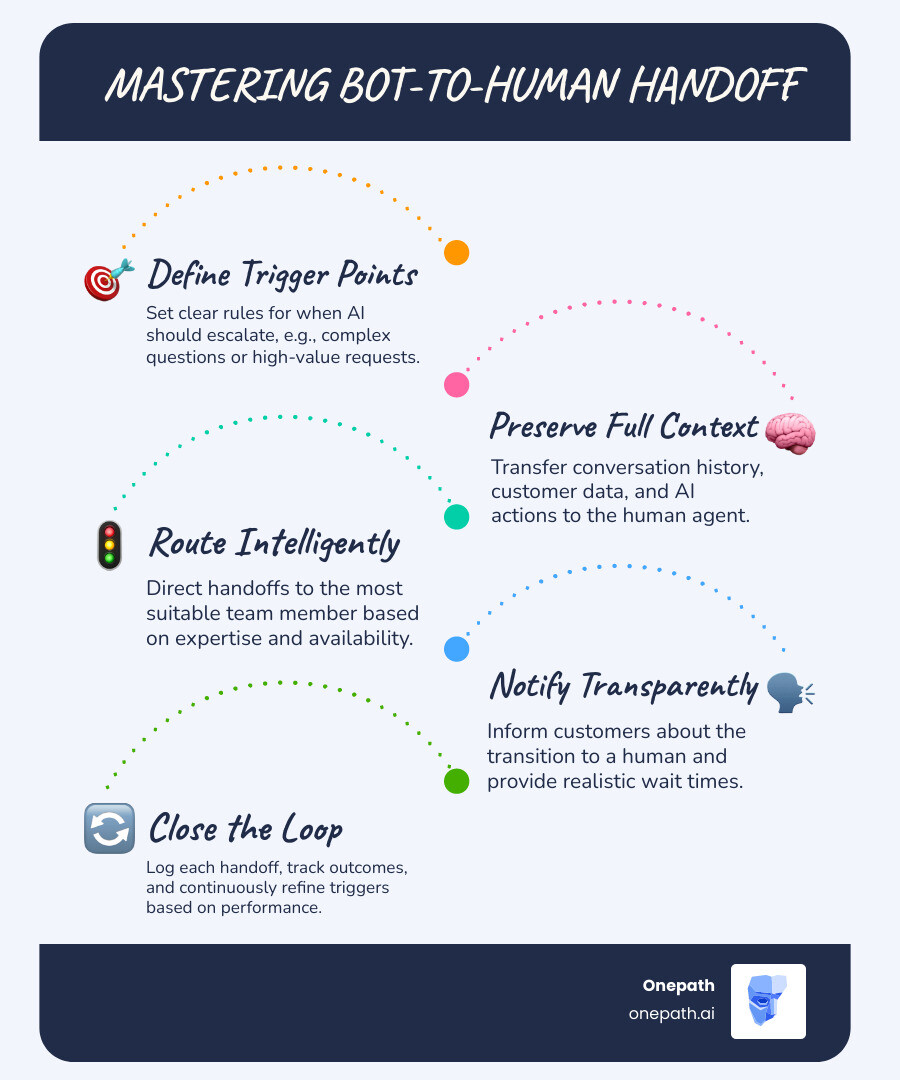
Master bot human handoff with these essential steps:
1. Define clear trigger points - Set rules for when your AI should escalate (complex questions, frustration signals, high-value requests)
2. Preserve full context - Transfer conversation history, customer data, and AI decisions to your human agent
3. Route intelligently - Direct handoffs to the right team member based on expertise and availability
4. Notify transparently - Tell customers they're being connected to a human and provide realistic wait times
5. Close the loop - Log every handoff, track outcomes, and refine your triggers based on performance data
If you run a home service business, you already know the drill: a potential customer reaches out after hours, your bot answers their question about scheduling, but then they ask something complicated—like whether you can handle an emergency repair and coordinate with their insurance company. Your bot doesn't know what to do. If it fumbles the handoff or just goes silent, that lead is gone. Research shows that communication failures are a leading cause of preventable errors across industries, and in sales, a botched transition can mean the difference between booking the job and losing it to a competitor who picks up the phone. The challenge isn't whether to use automation—it's making sure your automation knows when to step aside and let a human take over, without making your customer repeat themselves or feel like they're being passed around.
What is a Human Handoff in AI Customer Service?
At its core, a human handoff is about delegation. Think of your AI as a highly efficient receptionist. It can handle the "low-hanging fruit"—scheduling standard maintenance, answering FAQs about your service area, or gathering basic contact info. But when a conversation shifts into high-stakes territory, the AI needs to pass the baton.
In human-handoff, this isn't just a simple "forwarding" of a message. It is a sophisticated exchange of authority. A virtual agent identifies that a task has exceeded its "complexity threshold" and signals a human representative to step in. This creates a hybrid support model where you get the speed of AI and the empathy of a human.
One of the most critical aspects is context continuity. In high-reliability industries like healthcare or aviation, a "handoff" is a life-or-death moment. If a nurse leaves a shift without telling the next nurse about a patient's allergy, the results are disastrous. In your home service business, the stakes are your reputation and revenue. A successful handoff ensures the human agent sees the entire chat history, so they don't ask the customer, "What's your address?" for the third time.
Furthermore, modern systems allow for bi-directional communication. This means that after a human resolves a complex billing dispute, they can hand the conversation back to the AI to handle the final scheduling or follow-up survey. This loop keeps your team focused on the work that requires their expertise while the AI handles the administrative heavy lifting.
Why Seamless Transitions Matter for Lead Retention
We have all been there: you're chatting with a bot, it gets confused, and suddenly you're staring at a blank screen or a "Please call our office" message. That is where leads go to die. Seamless transitions are the antidote to "lead ghosting."
When a human handoff is executed perfectly, it builds immense trust. Customers feel heard and valued when a human enters the conversation at exactly the right moment with full knowledge of their problem. This is especially true for complex problem solving—like a homeowner trying to decide between a full HVAC replacement or a localized repair. They need empathy and professional judgment that AI simply cannot provide yet.
The statistics back this up. Implementation of standardized handoff bundles in professional settings has been shown to markedly reduce errors and preventable adverse events. In the business world, using advanced AI agents can lead to 70% greater accuracy compared to DIY approaches. By providing accuracy oversight, your human team can catch any AI "hallucinations" or errors before they reach the customer.
Beyond immediate lead retention, these handoffs provide incredible AI training opportunities. Every time a human takes over, the system learns. By observing how your best sales rep handles a "price shopper" or an angry customer, the AI's intent recognition becomes sharper, making future interactions even smoother.
Common Scenarios That Require Human Intervention
Knowing when to step in is just as important as knowing how. We recommend setting up specific "trigger points" that automatically alert your team. Here are the most common scenarios:
• Complex Inquiries: If a customer asks about loan applications for a major home renovation or complex insurance claims, the AI should immediately flag a human.
• Customer Frustration: Using sentiment analysis, the AI can detect angry tones, excessive exclamation points, or keywords like "terrible" or "talk to a person."
• High-Value Leads: If a lead indicates they are looking for a multi-system install or a whole-home repiping, you want your best closer on that chat immediately.
• Product Customization: When a customer has very specific, non-standard needs (e.g., "I have a 1920s historic home with no ductwork"), human expertise is non-negotiable.
• Billing Disputes: Money is emotional. Any mention of an incorrect charge or a refund request should trigger an instant handoff to prevent escalation.
How to Build a Perfect Human Handoff Workflow
Building a workflow that doesn't feel clunky requires a mix of smart tech and clear internal rules.
• Speed — Manual Handoff: Slow (requires human monitoring) — Automated AI Handoff: Instant (triggered by AI)
• Context — Manual Handoff: Often lost or summarized — Automated AI Handoff: Full history preserved
• Routing — Manual Handoff: Random or "first see" — Automated AI Handoff: Skill-based/Expertise-based
• Customer Experience — Manual Handoff: High friction/Wait times — Automated AI Handoff: Seamless transition
To get started, you need a system that utilizes intent recognition. The software should analyze the "what" behind the customer's message. If the intent matches a "human-required" category, the handoff begins. For more details on setting this up, check out More info about human-handoff services.
Key Elements of a Successful Human Handoff
A successful human handoff rests on two pillars: context and communication.
1. Context Preservation: The human agent must have access to a shared console showing exactly what the bot said.
2. Metadata Transfer: It’s not just the words; it’s the data. The agent should see the customer's CRM profile, previous service history, and any "tags" the AI applied (e.g., "Urgent," "Repeat Customer").
3. Real-Time Notifications: Your team shouldn't have to go looking for handoffs. They should receive instant alerts via SMS, email, or desktop notifications.
4. Transparency with the Customer: Never "stealth" a handoff. Tell the customer: "I'm connecting you with our senior technician, Mike, who can answer that technical question. He'll be with you in about two minutes."
Best Practices for Optimizing Your Human Handoff
We can learn a lot from high-stakes fields like medicine. In hospitals, professionals use the I-PASS protocol (Illness severity, Patient summary, Action list, Situation awareness, Synthesis by receiver) or the SBAR framework (Situation, Background, Assessment, Recommendation).
For your home service business, we can adapt these into a "Sales Handoff" version:
• Read-Back Techniques: When the human joins, they should summarize: "I see you're asking about the warranty on our copper piping, is that correct?" This proves you've read the history.
• Minimizing Interruptions: Ensure your agents have a dedicated "unified inbox" so they aren't jumping between five different apps to find the chat.
• Standardized Mnemonics: Create a simple checklist for your reps to fill out after they take over a lead to ensure no data is lost.
• Continuous Optimization: Review your "failed" handoffs monthly. Did the AI wait too long? Did the human miss the notification? Adjust your triggers accordingly.
Measuring and Improving Handoff Performance
You can't improve what you don't measure. To master the human handoff, you need to track specific metrics:
• Handoff Rate: What percentage of your chats require human intervention? If it's too high, your bot might be too simple. If it's too low, you might be missing complex sales opportunities.
• Human Handle Time: How long does it take for your rep to close the deal once they take over?
• Context-Loss Indicators: How often does a customer say "Like I already told the bot..."? This is a red flag that your context transfer is broken.
• First-Contact Resolution: Are you solving the problem in one go, or is there a lot of back-and-forth after the handoff?
Frequently Asked Questions about Human Handoff
When should an AI agent trigger a handoff?
An AI agent should trigger a handoff when its confidence score drops below a certain level, when it detects specific "crisis" keywords, when a high-value service is mentioned, or when the customer explicitly asks to "speak to a human."
How can I prevent context loss during a transition?
The best way to prevent context loss is to use an integrated CRM and AI platform. This ensures that the chat transcript, customer tags, and AI-detected intent are all visible in a single window for the human agent.
What metrics should I track to improve my handoff process?
Focus on your handoff rate, average response time (how long the customer waits for the human), and Customer Satisfaction (CSAT) scores specifically for handed-off conversations.
Conclusion
At Onepath, we believe that technology should never come at the expense of the human touch. Our AI Lead Manager and all-in-one CRM are designed specifically for home service businesses that can't afford to let a single lead slip through the cracks. With our 72-hour setup, we provide full customer journey visibility and 24/7 human support to ensure your human handoff is always flawless.
Don't let your bot ghost your leads. By combining the 24/7 responsiveness of AI with the expert care of your team, you can ensure that every homeowner feels like your top priority.

Why Every Lead Counts—And How Human Handoff Keeps Them from Slipping Away
Human handoff is the seamless transition of a conversation from an AI agent or chatbot to a live human representative when the automated system reaches the limits of its capability or detects that personal attention is required. In customer service and sales, this handoff involves transferring not just the conversation itself, but the full context—what the AI learned, what actions it took, what the customer needs—so the human can pick up exactly where the bot left off.
Master bot human handoff with these essential steps:
- Define clear trigger points - Set rules for when your AI should escalate (complex questions, frustration signals, high-value requests)
- Preserve full context - Transfer conversation history, customer data, and AI decisions to your human agent
- Route intelligently - Direct handoffs to the right team member based on expertise and availability
- Notify transparently - Tell customers they're being connected to a human and provide realistic wait times
- Close the loop - Log every handoff, track outcomes, and refine your triggers based on performance data
If you run a home service business, you already know the drill: a potential customer reaches out after hours, your bot answers their question about scheduling, but then they ask something complicated—like whether you can handle an emergency repair and coordinate with their insurance company. Your bot doesn't know what to do. If it fumbles the handoff or just goes silent, that lead is gone. Research shows that communication failures are a leading cause of preventable errors across industries, and in sales, a botched transition can mean the difference between booking the job and losing it to a competitor who picks up the phone. The challenge isn't whether to use automation—it's making sure your automation knows when to step aside and let a human take over, without making your customer repeat themselves or feel like they're being passed around.
What is a Human Handoff in AI Customer Service?
At its core, a human handoff is about delegation. Think of your AI as a highly efficient receptionist. It can handle the "low-hanging fruit"—scheduling standard maintenance, answering FAQs about your service area, or gathering basic contact info. But when a conversation shifts into high-stakes territory, the AI needs to pass the baton.
In human-handoff, this isn't just a simple "forwarding" of a message. It is a sophisticated exchange of authority. A virtual agent identifies that a task has exceeded its "complexity threshold" and signals a human representative to step in. This creates a hybrid support model where you get the speed of AI and the empathy of a human.
One of the most critical aspects is context continuity. In high-reliability industries like healthcare or aviation, a "handoff" is a life-or-death moment. If a nurse leaves a shift without telling the next nurse about a patient's allergy, the results are disastrous. In your home service business, the stakes are your reputation and revenue. A successful handoff ensures the human agent sees the entire chat history, so they don't ask the customer, "What's your address?" for the third time.
Furthermore, modern systems allow for bi-directional communication. This means that after a human resolves a complex billing dispute, they can hand the conversation back to the AI to handle the final scheduling or follow-up survey. This loop keeps your team focused on the work that requires their expertise while the AI handles the administrative heavy lifting.
Why Seamless Transitions Matter for Lead Retention
We have all been there: you're chatting with a bot, it gets confused, and suddenly you're staring at a blank screen or a "Please call our office" message. That is where leads go to die. Seamless transitions are the antidote to "lead ghosting."
When a human handoff is executed perfectly, it builds immense trust. Customers feel heard and valued when a human enters the conversation at exactly the right moment with full knowledge of their problem. This is especially true for complex problem solving—like a homeowner trying to decide between a full HVAC replacement or a localized repair. They need empathy and professional judgment that AI simply cannot provide yet.
The statistics back this up. Implementation of standardized handoff bundles in professional settings has been shown to markedly reduce errors and preventable adverse events. In the business world, using advanced AI agents can lead to 70% greater accuracy compared to DIY approaches. By providing accuracy oversight, your human team can catch any AI "hallucinations" or errors before they reach the customer.
Beyond immediate lead retention, these handoffs provide incredible AI training opportunities. Every time a human takes over, the system learns. By observing how your best sales rep handles a "price shopper" or an angry customer, the AI's intent recognition becomes sharper, making future interactions even smoother.
Common Scenarios That Require Human Intervention
Knowing when to step in is just as important as knowing how. We recommend setting up specific "trigger points" that automatically alert your team. Here are the most common scenarios:
- Complex Inquiries: If a customer asks about loan applications for a major home renovation or complex insurance claims, the AI should immediately flag a human.
- Customer Frustration: Using sentiment analysis, the AI can detect angry tones, excessive exclamation points, or keywords like "terrible" or "talk to a person."
- High-Value Leads: If a lead indicates they are looking for a multi-system install or a whole-home repiping, you want your best closer on that chat immediately.
- Product Customization: When a customer has very specific, non-standard needs (e.g., "I have a 1920s historic home with no ductwork"), human expertise is non-negotiable.
- Billing Disputes: Money is emotional. Any mention of an incorrect charge or a refund request should trigger an instant handoff to prevent escalation.
How to Build a Perfect Human Handoff Workflow
Building a workflow that doesn't feel clunky requires a mix of smart tech and clear internal rules.
| Feature | Manual Handoff | Automated AI Handoff |
|---|---|---|
| Speed | Slow (requires human monitoring) | Instant (triggered by AI) |
| Context | Often lost or summarized | Full history preserved |
| Routing | Random or "first see" | Skill-based/Expertise-based |
| Customer Experience | High friction/Wait times | Seamless transition |
To get started, you need a system that utilizes intent recognition. The software should analyze the "what" behind the customer's message. If the intent matches a "human-required" category, the handoff begins. For more details on setting this up, check out More info about human-handoff services.
Key Elements of a Successful Human Handoff
A successful human handoff rests on two pillars: context and communication.
- Context Preservation: The human agent must have access to a shared console showing exactly what the bot said.
- Metadata Transfer: It’s not just the words; it’s the data. The agent should see the customer's CRM profile, previous service history, and any "tags" the AI applied (e.g., "Urgent," "Repeat Customer").
- Real-Time Notifications: Your team shouldn't have to go looking for handoffs. They should receive instant alerts via SMS, email, or desktop notifications.
- Transparency with the Customer: Never "stealth" a handoff. Tell the customer: "I'm connecting you with our senior technician, Mike, who can answer that technical question. He'll be with you in about two minutes."
Best Practices for Optimizing Your Human Handoff
We can learn a lot from high-stakes fields like medicine. In hospitals, professionals use the I-PASS protocol (Illness severity, Patient summary, Action list, Situation awareness, Synthesis by receiver) or the SBAR framework (Situation, Background, Assessment, Recommendation).
For your home service business, we can adapt these into a "Sales Handoff" version:
- Read-Back Techniques: When the human joins, they should summarize: "I see you're asking about the warranty on our copper piping, is that correct?" This proves you've read the history.
- Minimizing Interruptions: Ensure your agents have a dedicated "unified inbox" so they aren't jumping between five different apps to find the chat.
- Standardized Mnemonics: Create a simple checklist for your reps to fill out after they take over a lead to ensure no data is lost.
- Continuous Optimization: Review your "failed" handoffs monthly. Did the AI wait too long? Did the human miss the notification? Adjust your triggers accordingly.
Measuring and Improving Handoff Performance
You can't improve what you don't measure. To master the human handoff, you need to track specific metrics:
- Handoff Rate: What percentage of your chats require human intervention? If it's too high, your bot might be too simple. If it's too low, you might be missing complex sales opportunities.
- Human Handle Time: How long does it take for your rep to close the deal once they take over?
- Context-Loss Indicators: How often does a customer say "Like I already told the bot..."? This is a red flag that your context transfer is broken.
- First-Contact Resolution: Are you solving the problem in one go, or is there a lot of back-and-forth after the handoff?
Frequently Asked Questions about Human Handoff
When should an AI agent trigger a handoff?
An AI agent should trigger a handoff when its confidence score drops below a certain level, when it detects specific "crisis" keywords, when a high-value service is mentioned, or when the customer explicitly asks to "speak to a human."
How can I prevent context loss during a transition?
The best way to prevent context loss is to use an integrated CRM and AI platform. This ensures that the chat transcript, customer tags, and AI-detected intent are all visible in a single window for the human agent.
What metrics should I track to improve my handoff process?
Focus on your handoff rate, average response time (how long the customer waits for the human), and Customer Satisfaction (CSAT) scores specifically for handed-off conversations.
Conclusion
At Onepath, we believe that technology should never come at the expense of the human touch. Our AI Lead Manager and all-in-one CRM are designed specifically for home service businesses that can't afford to let a single lead slip through the cracks. With our 72-hour setup, we provide full customer journey visibility and 24/7 human support to ensure your human handoff is always flawless.
Don't let your bot ghost your leads. By combining the 24/7 responsiveness of AI with the expert care of your team, you can ensure that every homeowner feels like your top priority.
Boost Your Lead Conversions. Start Using Onepath Today.
Onepath is your AI Lead Manager, built by tech experts and home service pros. It responds instantly, schedules appointments, personalizes customer interactions, and ensures no lead slips through the cracks—backed by 24/7 human support.
[ Schedule Discovery call ].webp)