.svg)

Multi-Channel Lead Capture Best Practices for B2B Marketing
.webp)
Why Multi-Channel Lead Capture Matters for Growing Home Service Businesses

Multi-channel lead capture is the practice of identifying and collecting potential customer information across multiple platforms—including your website, social media, email, phone calls, text messages, and paid advertising—to ensure no opportunity slips through the cracks. If you're running a home service business, you already know the frustration: a prospect sees your Facebook ad but calls three days later after finding you on Google, or they text your business number after visiting your website. Without a system that tracks all these touchpoints, you're flying blind, unable to see which marketing efforts actually drive results or how customers really find you.
What is multi-channel lead capture?
• A strategy to collect and track leads from website forms, phone calls, texts, social media, email, search ads, and other platforms in one unified system
• Assigns unique tracking identifiers (like phone numbers or URLs) to each channel so you know exactly where every lead originated
• Automatically enriches lead data and centralizes it in your CRM for complete visibility
• Enables faster response times through instant notifications and automated routing based on lead source and behavior
Research shows that businesses using two or more channels see 166% higher engagement rates, and 51% of companies now use at least eight channels to connect with customers. Yet most home service businesses still operate in silos—your website leads go to one inbox, phone calls aren't tracked, and social media messages get lost. This fragmentation costs you leads, wastes marketing spend, and leaves your team scrambling to piece together the customer journey. The modern buyer doesn't follow a straight line; 85% start their search on one device and finish on another, engaging with your brand multiple times before they're ready to book.
For deeper strategies on unifying your customer data, explore our guide on AI Lead Management Solutions, or if you're ready to stop losing leads entirely, check out Stop Losing Leads.
The Strategic Importance of Multi-Channel Lead Capture
In the past, a homeowner might find your number in the yellow pages and call you. Today, the path to a booked appointment is a winding road. A homeowner might notice your service truck in their neighborhood, look you up on their smartphone while at work, and finally fill out a form on their laptop at home. If you only track that final form fill, you're missing the big picture.
The strategic shift from single-channel to multi-channel lead capture allows us to move away from "throwing darts in the dark." By implementing Multi-Channel Lead Capture AI, we can see the entire conversion path. This visibility is essential because single-channel marketing creates blind spots. If you think all your leads come from SEO but ignore the fact that they first clicked a social media ad, you might accidentally cut the budget for the very thing that started the conversation.
Capturing the Full Customer Journey
Most digital consumers—about 85%—start their journey on one device and finish on another. This cross-device behavior makes touchpoint tracking more critical than ever. Indirect engagement is the new norm; a prospect might see your "Emergency Plumbing" ad on Google but wait to call until they see a positive review on your Google Business Profile.
By mapping the journey, we can identify which "gears" in our marketing machine are turning effectively. For example, you might find that while email marketing provides a "gold mine" of prospects (with global revenue predicted to reach 17.9 billion dollars by 2027), your social media channels are better at building the initial trust required for a homeowner to hand over their email address.
Improving Sales and Marketing Alignment
One of the biggest silent killers of growth is the wall between marketing (the people getting the leads) and sales (the people closing the jobs). Multi-channel capture tears down this wall through data transparency. When every lead—whether it came from a text, a call, or a LinkedIn message—is funneled into a central repository, everyone is on the same page.
This unified approach improves team productivity significantly. Instead of a sales rep asking, "Where did this lead come from?" they can see the entire history: the pages the lead visited, the ads they clicked, and the previous texts they sent. This context allows for a much warmer, more personalized sales call.
Essential Channels for Modern Lead Generation
To build a robust multi-channel lead capture strategy, we need to be where our customers are. This doesn't mean just "being on the internet"—it means having active, tracked gateways on every platform. Utilizing AI Lead Management Solutions helps us manage these various streams without getting overwhelmed.
Website and Form Optimization
Your website is your digital storefront, but if your forms are causing "abandonment," you're losing money. Statistics show that 76% of buyers resent disjointed experiences. If a lead fills out a form and then has to repeat their information to a rep later, that’s a fail.
Modern lead capture involves real-time visitor identification. When someone fills out a form, the system should instantly capture that data and enrich it with business or demographic information. This allows you to prioritize leads based on intent. For instance, someone downloading a "DIY Maintenance Guide" is a different priority than someone filling out an "Emergency Repair" form. To prevent these high-intent prospects from slipping away, we focus on strategies to Stop Losing Leads.
Social Media and Paid Advertising
Social media isn't just for brand awareness; it’s a powerful engine for lead generation. Platforms like LinkedIn are excellent for B2B outreach, while Facebook and Instagram are staples for local home services. Using retargeting ads is a "best practice" that keeps your brand top-of-mind. If a homeowner visits your site but doesn't book, a well-timed ad showing a recent success story in their neighborhood can bring them back.
We also use "lead magnets"—valuable content like eBooks or webinars—to exchange information for contact details. The key is consistency; your messaging on a social media ad must match the experience they have when they land on your website.
Advanced Workflows for Multi-Channel Lead Management
Capturing the lead is only step one. What happens in the five minutes after capture determines your conversion rate. Leads contacted within five minutes convert at three times the rate of those who wait just thirty minutes. This is where Automated Lead Engagement and Follow-Up becomes your secret weapon.
Implementing Multi-Channel Lead Capture Workflows
Automation sequences allow us to respond to leads 24/7. Imagine a homeowner’s water heater bursts at 2:00 AM. They text your business. An AI Lead Manager can instantly respond, ask qualifying questions (e.g., "Is it leaking or just not heating?"), and even schedule the appointment for the next morning.
These workflows should include:
1. Immediate Response: An automated text or email acknowledging the lead.
2. Lead Scoring: Assigning points based on actions (e.g., visiting the pricing page adds 20 points).
3. Behavioral Triggers: If a lead opens an email three times, the system notifies a human rep to call them immediately.
4. Nurture Campaigns: Sending helpful tips to "warm" leads who aren't ready to buy yet.
Centralizing Data to Eliminate Silos
Data silos are the "silent conversion killer." When your call data lives in one app and your website leads live in another, you lose the "thread" of the conversation. By integrating your channels into an AI Sales Assistant, you create unified records.
This centralization ensures that if a customer calls after sending a text, the person answering the phone knows exactly what was said in the text. It makes your business look professional, organized, and—most importantly—attentive.
Overcoming Challenges in Multi-Channel Tracking
It’s not all sunshine and rainbows; multi-channel lead capture comes with problems. Recent privacy updates, like the deprecation of third-party cookies and Apple’s iOS 14.5 update, have made traditional "pixel-based" tracking much harder. We can no longer rely on following people around the web with "creepy" ads.
Instead, we focus on "permission-based data"—information the customer willingly gives us. We also have to manage technical challenges like phone number consistency. Some business owners worry that using unique tracking numbers for different ads will hurt their SEO. However, extensive testing shows that as long as your primary "NAP" (Name, Address, Phone) remains consistent on your Google Business Profile, using tracking numbers on specific landing pages does not negatively impact organic rankings.
For more on managing these complexities, see our approach to Automated Lead Management.
Measuring Multi-Channel Lead Capture Success
You can't manage what you don't measure. We use multi-touch attribution models to give credit where it’s due. If a lead saw a social ad, read a blog post, and then called, the attribution model ensures the social ad gets some credit for the "assist."
Key metrics to track include:
• Time-to-first-contact: How fast are we responding?
• Channel Conversion Rate: Which platform gives us the highest quality leads?
• Cost Per Qualified Lead: Are we spending our budget efficiently?
• Lead-to-Booking Ratio: How many captured leads actually turn into paid jobs?
Frequently Asked Questions about Multi-Channel Lead Capture
Does changing phone numbers for tracking hurt SEO rankings?
This is a common concern. The short answer is: No. While local SEO relies on a consistent Name, Address, and Phone number (NAP) across the web, using dynamic number insertion (DNI) for tracking purposes is a standard industry practice. As long as your Google Business Profile (GBP) and main website contact page maintain your primary number, using unique tracking numbers for your PPC ads or social campaigns will not hurt your organic rankings.
Can small businesses effectively manage multiple lead channels?
Absolutely. In fact, small businesses often see the most dramatic benefits from multi-channel lead capture because it allows a small team to "punch above their weight class." By using automation, a five-person team can manage the lead volume of a ten-person team. It’s about working smarter, not harder, and using tools that scale with you.
How does multi-channel capture improve lead response times?
By centralizing all channels, you eliminate the need to check five different apps. When a lead comes in from anywhere, your team receives one instant notification. Combined with automated routing, the lead is immediately put in front of the right person (or handled by an AI manager), ensuring that "speed to lead" becomes your competitive advantage.
Conclusion
In the competitive world of home services, the winner isn't always the one with the biggest ad budget—it's the one who captures and responds to every lead most effectively. Multi-channel lead capture ensures that whether a customer finds you on a laptop, a smartphone, or through a social media ad, their journey is seamless and your response is instant.
At Onepath, we provide an AI Lead Manager and all-in-one CRM specifically designed for the needs of home service businesses. Our system instantly responds to leads, schedules your appointments, and personalizes every interaction across all your channels. With a 72-hour setup, 24/7 human support, and full customer journey visibility, we make sure you never lose a lead again.
Ready to see the full picture of your marketing? Get started with Multi-Channel Lead Capture AI today and turn every touchpoint into a booked job.
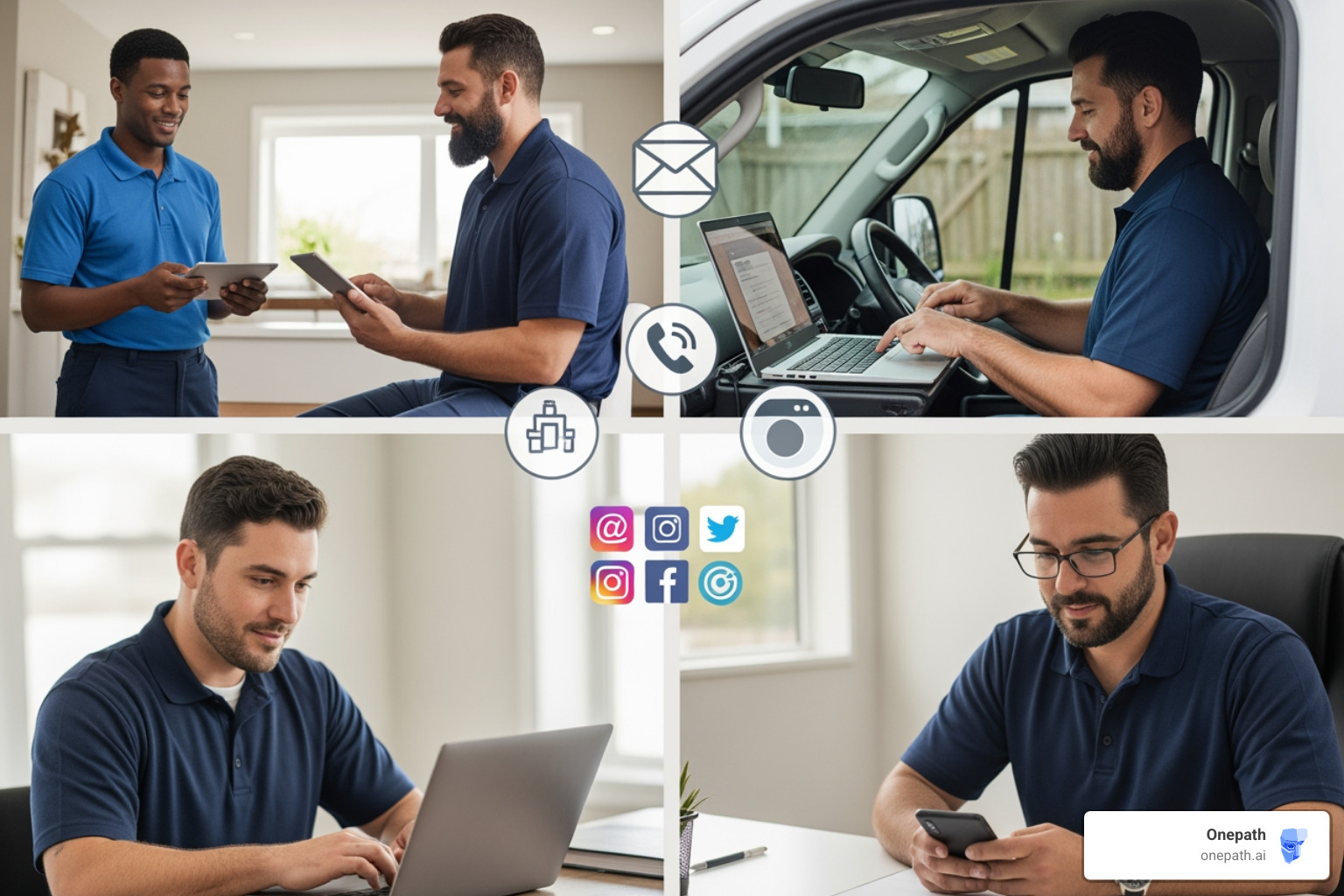
Why Multi-Channel Lead Capture Matters for Growing Home Service Businesses
Multi-channel lead capture is the practice of identifying and collecting potential customer information across multiple platforms—including your website, social media, email, phone calls, text messages, and paid advertising—to ensure no opportunity slips through the cracks. If you're running a home service business, you already know the frustration: a prospect sees your Facebook ad but calls three days later after finding you on Google, or they text your business number after visiting your website. Without a system that tracks all these touchpoints, you're flying blind, unable to see which marketing efforts actually drive results or how customers really find you.
What is multi-channel lead capture?
- A strategy to collect and track leads from website forms, phone calls, texts, social media, email, search ads, and other platforms in one unified system
- Assigns unique tracking identifiers (like phone numbers or URLs) to each channel so you know exactly where every lead originated
- Automatically enriches lead data and centralizes it in your CRM for complete visibility
- Enables faster response times through instant notifications and automated routing based on lead source and behavior
Research shows that businesses using two or more channels see 166% higher engagement rates, and 51% of companies now use at least eight channels to connect with customers. Yet most home service businesses still operate in silos—your website leads go to one inbox, phone calls aren't tracked, and social media messages get lost. This fragmentation costs you leads, wastes marketing spend, and leaves your team scrambling to piece together the customer journey. The modern buyer doesn't follow a straight line; 85% start their search on one device and finish on another, engaging with your brand multiple times before they're ready to book.
For deeper strategies on unifying your customer data, explore our guide on AI Lead Management Solutions, or if you're ready to stop losing leads entirely, check out Stop Losing Leads.
The Strategic Importance of Multi-Channel Lead Capture
In the past, a homeowner might find your number in the yellow pages and call you. Today, the path to a booked appointment is a winding road. A homeowner might notice your service truck in their neighborhood, look you up on their smartphone while at work, and finally fill out a form on their laptop at home. If you only track that final form fill, you're missing the big picture.
The strategic shift from single-channel to multi-channel lead capture allows us to move away from "throwing darts in the dark." By implementing Multi-Channel Lead Capture AI, we can see the entire conversion path. This visibility is essential because single-channel marketing creates blind spots. If you think all your leads come from SEO but ignore the fact that they first clicked a social media ad, you might accidentally cut the budget for the very thing that started the conversation.
Capturing the Full Customer Journey
Most digital consumers—about 85%—start their journey on one device and finish on another. This cross-device behavior makes touchpoint tracking more critical than ever. Indirect engagement is the new norm; a prospect might see your "Emergency Plumbing" ad on Google but wait to call until they see a positive review on your Google Business Profile.
By mapping the journey, we can identify which "gears" in our marketing machine are turning effectively. For example, you might find that while email marketing provides a "gold mine" of prospects (with global revenue predicted to reach 17.9 billion dollars by 2027), your social media channels are better at building the initial trust required for a homeowner to hand over their email address.
Improving Sales and Marketing Alignment
One of the biggest silent killers of growth is the wall between marketing (the people getting the leads) and sales (the people closing the jobs). Multi-channel capture tears down this wall through data transparency. When every lead—whether it came from a text, a call, or a LinkedIn message—is funneled into a central repository, everyone is on the same page.
This unified approach improves team productivity significantly. Instead of a sales rep asking, "Where did this lead come from?" they can see the entire history: the pages the lead visited, the ads they clicked, and the previous texts they sent. This context allows for a much warmer, more personalized sales call.
Essential Channels for Modern Lead Generation
To build a robust multi-channel lead capture strategy, we need to be where our customers are. This doesn't mean just "being on the internet"—it means having active, tracked gateways on every platform. Utilizing AI Lead Management Solutions helps us manage these various streams without getting overwhelmed.
Website and Form Optimization
Your website is your digital storefront, but if your forms are causing "abandonment," you're losing money. Statistics show that 76% of buyers resent disjointed experiences. If a lead fills out a form and then has to repeat their information to a rep later, that’s a fail.
Modern lead capture involves real-time visitor identification. When someone fills out a form, the system should instantly capture that data and enrich it with business or demographic information. This allows you to prioritize leads based on intent. For instance, someone downloading a "DIY Maintenance Guide" is a different priority than someone filling out an "Emergency Repair" form. To prevent these high-intent prospects from slipping away, we focus on strategies to Stop Losing Leads.
Social Media and Paid Advertising
Social media isn't just for brand awareness; it’s a powerful engine for lead generation. Platforms like LinkedIn are excellent for B2B outreach, while Facebook and Instagram are staples for local home services. Using retargeting ads is a "best practice" that keeps your brand top-of-mind. If a homeowner visits your site but doesn't book, a well-timed ad showing a recent success story in their neighborhood can bring them back.
We also use "lead magnets"—valuable content like eBooks or webinars—to exchange information for contact details. The key is consistency; your messaging on a social media ad must match the experience they have when they land on your website.
Advanced Workflows for Multi-Channel Lead Management
Capturing the lead is only step one. What happens in the five minutes after capture determines your conversion rate. Leads contacted within five minutes convert at three times the rate of those who wait just thirty minutes. This is where Automated Lead Engagement and Follow-Up becomes your secret weapon.
Implementing Multi-Channel Lead Capture Workflows
Automation sequences allow us to respond to leads 24/7. Imagine a homeowner’s water heater bursts at 2:00 AM. They text your business. An AI Lead Manager can instantly respond, ask qualifying questions (e.g., "Is it leaking or just not heating?"), and even schedule the appointment for the next morning.
These workflows should include:
- Immediate Response: An automated text or email acknowledging the lead.
- Lead Scoring: Assigning points based on actions (e.g., visiting the pricing page adds 20 points).
- Behavioral Triggers: If a lead opens an email three times, the system notifies a human rep to call them immediately.
- Nurture Campaigns: Sending helpful tips to "warm" leads who aren't ready to buy yet.
Centralizing Data to Eliminate Silos
Data silos are the "silent conversion killer." When your call data lives in one app and your website leads live in another, you lose the "thread" of the conversation. By integrating your channels into an AI Sales Assistant, you create unified records.
This centralization ensures that if a customer calls after sending a text, the person answering the phone knows exactly what was said in the text. It makes your business look professional, organized, and—most importantly—attentive.
Overcoming Challenges in Multi-Channel Tracking
It’s not all sunshine and rainbows; multi-channel lead capture comes with problems. Recent privacy updates, like the deprecation of third-party cookies and Apple’s iOS 14.5 update, have made traditional "pixel-based" tracking much harder. We can no longer rely on following people around the web with "creepy" ads.
Instead, we focus on "permission-based data"—information the customer willingly gives us. We also have to manage technical challenges like phone number consistency. Some business owners worry that using unique tracking numbers for different ads will hurt their SEO. However, extensive testing shows that as long as your primary "NAP" (Name, Address, Phone) remains consistent on your Google Business Profile, using tracking numbers on specific landing pages does not negatively impact organic rankings.
For more on managing these complexities, see our approach to Automated Lead Management.
Measuring Multi-Channel Lead Capture Success
You can't manage what you don't measure. We use multi-touch attribution models to give credit where it’s due. If a lead saw a social ad, read a blog post, and then called, the attribution model ensures the social ad gets some credit for the "assist."
Key metrics to track include:
- Time-to-first-contact: How fast are we responding?
- Channel Conversion Rate: Which platform gives us the highest quality leads?
- Cost Per Qualified Lead: Are we spending our budget efficiently?
- Lead-to-Booking Ratio: How many captured leads actually turn into paid jobs?
Frequently Asked Questions about Multi-Channel Lead Capture
Does changing phone numbers for tracking hurt SEO rankings?
This is a common concern. The short answer is: No. While local SEO relies on a consistent Name, Address, and Phone number (NAP) across the web, using dynamic number insertion (DNI) for tracking purposes is a standard industry practice. As long as your Google Business Profile (GBP) and main website contact page maintain your primary number, using unique tracking numbers for your PPC ads or social campaigns will not hurt your organic rankings.
Can small businesses effectively manage multiple lead channels?
Absolutely. In fact, small businesses often see the most dramatic benefits from multi-channel lead capture because it allows a small team to "punch above their weight class." By using automation, a five-person team can manage the lead volume of a ten-person team. It’s about working smarter, not harder, and using tools that scale with you.
How does multi-channel capture improve lead response times?
By centralizing all channels, you eliminate the need to check five different apps. When a lead comes in from anywhere, your team receives one instant notification. Combined with automated routing, the lead is immediately put in front of the right person (or handled by an AI manager), ensuring that "speed to lead" becomes your competitive advantage.
Conclusion
In the competitive world of home services, the winner isn't always the one with the biggest ad budget—it's the one who captures and responds to every lead most effectively. Multi-channel lead capture ensures that whether a customer finds you on a laptop, a smartphone, or through a social media ad, their journey is seamless and your response is instant.
At Onepath, we provide an AI Lead Manager and all-in-one CRM specifically designed for the needs of home service businesses. Our system instantly responds to leads, schedules your appointments, and personalizes every interaction across all your channels. With a 72-hour setup, 24/7 human support, and full customer journey visibility, we make sure you never lose a lead again.
Ready to see the full picture of your marketing? Get started with Multi-Channel Lead Capture AI today and turn every touchpoint into a booked job.
Boost Your Lead Conversions. Start Using Onepath Today.
Onepath is your AI Lead Manager, built by tech experts and home service pros. It responds instantly, schedules appointments, personalizes customer interactions, and ensures no lead slips through the cracks—backed by 24/7 human support.
[ Schedule Discovery call ].webp)