.svg)

In Depth Guide to AI Appointment Booking for Pest Control
.webp)
Why Most Pest Control Businesses Lose Jobs Before 9 AM
AI appointment booking for pest control is changing how home service businesses capture leads, fill schedules, and reduce no-shows — without adding staff or working longer hours.
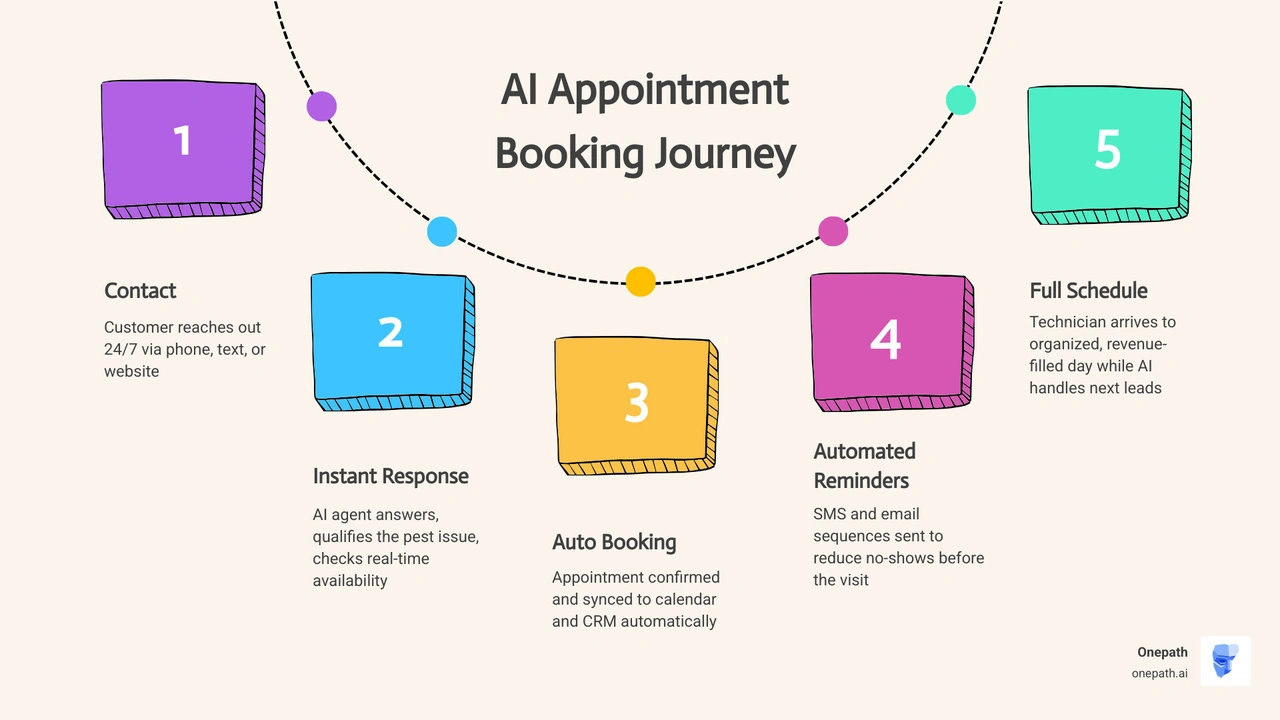
Here is a quick look at how it works:
- A customer contacts you — via phone, text, or your website — at any hour
- An AI agent responds instantly — answering questions, qualifying the pest issue, and checking availability in real time
- The appointment is booked automatically — confirmed in your calendar and synced to your CRM without any manual input
- Reminders go out automatically — reducing no-shows with SMS and email sequences before the scheduled visit
- You show up to a full, organized schedule — while the AI continues capturing the next lead
Think about what happens when a homeowner discovers termites in their crawl space at 9 PM on a Friday. They do not wait until Monday. They search, they call, and they book with whoever answers first. If your business goes to voicemail, that job — and the recurring contract that comes with it — goes to a competitor.
That is the core problem AI appointment booking for pest control solves. The pest control industry runs on urgency. Customers dealing with rodents, bed bugs, or a wasp nest are not browsing casually — they want help now. Research consistently shows that leads reached within five minutes convert at dramatically higher rates than those followed up an hour later.
For growing pest control businesses already stretched thin across field operations, routing, and customer service, manually answering every call and managing every booking is simply not sustainable. AI scheduling systems handle the front-end customer journey around the clock, so your team can focus on the work that actually requires them on-site.
Easy ai appointment booking for pest control word list:
- ai appointment booking for home services
- ai appointment booking for landscaping companies
- ai appointment booking for tree service companies
Why Your Business Needs AI Appointment Booking for Pest Control

Operating a pest control company in July 2026 means navigating a highly competitive landscape where response time is the single most critical factor in winning new accounts. Property owners facing active infestations are often in a state of high anxiety. If they hear a scuttling sound in their attic or spot a trail of carpenter ants in their kitchen, they want immediate assurance that help is on the way.
Unfortunately, standard office hours do not align with when these emergencies occur. Statistics indicate that approximately 40% of home service bookings are initiated outside of traditional business hours. When a business relies on a standard voicemail system or a delayed email response, it essentially hands those ready-to-buy leads to competitors who can confirm a booking instantly.
Furthermore, the pest control business model relies heavily on predictable, recurring revenue. Annual contracts for quarterly perimeter treatments, seasonal mosquito barriers, and ongoing rodent monitoring make up the financial backbone of successful operations. Every missed call is not just a single lost service call; it is a lost relationship that could have generated steady recurring revenue for years.
By utilizing AI Powered Appointment Booking, we can automate the repetitive administrative work of matching field technicians to open calendar slots, allowing your core team to focus on high-quality service delivery and customer retention.
How AI Handles Calls and Bookings 24/7
An AI appointment setter acts as an tireless, always-on digital office assistant. When a customer calls your main line, sends a text message, or interacts with your website chat widget in the middle of the night, the AI engages them within seconds.
By applying conversational intelligence, the system does not just present a static booking page; it conducts a natural, context-aware dialogue. For instance, if a homeowner sends a text at 11 PM regarding a wasp nest near their front door, the AI can ask clarifying questions to determine the nest's location, size, and level of activity. It then references your active database to confirm your service area, checks the real-time availability of your technicians, and secures the earliest available slot.
This rapid response window is crucial. Industry research shows that prospective clients are incredibly time-sensitive, and reaching a lead within the first five minutes increases the likelihood of conversion exponentially. By capturing and booking these leads instantly, your business remains fully operational and responsive 24 hours a day, seven days a week, without requiring you to pay for expensive overnight call centers or burn out your office staff. For a deeper look at how voice intelligence fits into this process, check out our AI Voice Agent Home Services Guide.
Comparing AI Scheduling to Traditional Manual Methods
To understand the true operational impact of implementing automated scheduling, it is helpful to contrast it directly with traditional manual systems.
| Operational Feature | Traditional Manual Scheduling | AI-Powered Automated Scheduling |
|---|---|---|
| Response Time | Minutes to hours (depending on staff availability and backlog) | Instantaneous (under 5 seconds across phone, SMS, and web chat) |
| Availability | Restricted to standard business hours (typically 8 AM - 5 PM) | 24/7/365 coverage, including holidays and weekends |
| Human Error Risk | High risk of double-booking, missing field notes, or routing errors | Zero double-booking; automatic CRM updates and exact data logging |
| Scalability | Scales linearly; requires hiring more staff as call volume increases | Unlimited concurrent interactions; handles seasonal surges effortlessly |
| After-Hours Capture | Voicemail or expensive third-party answering services | Direct, real-time qualifying and scheduling into your calendar |
| Operational Costs | High overhead including salaries, benefits, and office space | Low, predictable operating costs with high return on investment |
Manual scheduling is a repetitive, linear process that becomes increasingly fragile as your business grows. When your office staff spends hours playing phone tag to confirm, reschedule, or coordinate routes, they are pulled away from high-value tasks like customer relations and team management. AI-driven systems eliminate these bottlenecks entirely.
Key Features to Look For in a Scheduling System
Not all automated scheduling platforms are created equal. When evaluating options for your pest control business, it is vital to select a platform built to handle the unique constraints of the home services sector. A generic calendar link is no longer sufficient to meet modern customer expectations or handle complex field logistics. You need an intelligent system that understands service types, technician capabilities, and geographic routing. To learn more about these automated mechanics, read our guide on AI Automated Scheduling.
Core Features of AI Appointment Booking for Pest Control
A specialized scheduling system for pest control should possess several core capabilities:
- Intelligent Pest Triage and Identification: The AI should be trained to ask targeted questions to narrow down the pest type (e.g., bed bugs vs. carpet beetles) and assess the severity of the issue based on the customer's description.
- Smart Emergency Routing: The system must recognize high-priority keywords—such as active termite swarms or wildlife inside a living space—and fast-track those bookings or immediately alert an on-call technician.
- Dynamic Availability Rules: Different services require different time windows. A bed bug heat treatment takes significantly longer than a standard quarterly exterior spray. The AI must automatically adjust the slot duration based on the service selected.
- Safety and Preparation Guidance: The platform should automatically provide prep instructions (such as clearing kitchen counters before a cockroach treatment or keeping pets off the lawn after an exterior application) during the booking flow.
To see how these features streamline operations across the broader home services sector, you can review our AI Appointment Booking for Home Services article.
Seamless CRM and Calendar Integrations
Your scheduling system must not operate in a vacuum. To prevent administrative headaches, the AI must integrate directly with your existing field service management (FSM) software and customer relationship management (CRM) tools.
When a customer books an appointment through the AI, the system should instantly write the event to your master calendar, create or update the customer profile in your CRM, and populate the job notes with the pest details gathered during the conversation. This bidirectional synchronization ensures that your field technicians always have access to accurate, up-to-date information on their mobile devices, preventing double-bookings and scheduling conflicts.
For a comprehensive overview of how to orchestrate these connections across your business tools, refer to our Automated Scheduling AI Complete Guide.
Best Practices for Setting Up Your Automated System
Transitioning to automated scheduling is a straightforward process, but maximizing its effectiveness requires careful planning and strategic configuration. By structuring your system correctly from day one, you can ensure a seamless experience for both your customers and your field technicians. For a step-by-step roadmap, explore our Guide to AI Appointment Booking for Home Services.
How to Implement AI Appointment Booking for Pest Control Successfully
To achieve the best results, we recommend following these established industry best practices:
- Incorporate Strategic Buffer Times: Never schedule appointments back-to-back without accounting for travel. Configure your system to automatically add a 15-to-30-minute buffer window between appointments to give technicians adequate drive time and prevent scheduling delays.
- Establish Clear Availability Rules: Define precise working hours, lunch breaks, and regional service boundaries for each technician. This ensures the AI only offers appointments that fit logically within your team's existing routes.
- Deploy Multi-Channel Reminder Sequences: Implement automated confirmation and reminder flows via both SMS and email. Because text messages boast significantly higher open rates than emails, sending a 24-hour and a 1-hour SMS reminder is incredibly effective at cutting down on missed appointments.
- Offer Simple, One-Click Rescheduling: Make it easy for customers to modify their appointments. Providing a secure, direct link in their confirmation text to reschedule or cancel eliminates back-and-forth phone calls and encourages transparency.
- Keep Intake Forms Minimal: Only ask for essential details during the initial booking process (such as contact info, address, and primary pest issue). Requiring too much information upfront can lead to drop-offs before the booking is completed.
For a deeper dive into optimizing these scheduling workflows, consult our Ultimate AI Appointment Booking Guide.
Common Mistakes to Avoid During Setup
While the technology is highly intuitive, we frequently observe a few common missteps during the initial implementation phase:
- Neglecting Route Optimization: Allowing the AI to book appointments on opposite sides of your service territory back-to-back leads to excessive drive time and high fuel costs. Ensure your system uses geographic routing settings to group appointments by neighborhood.
- Failing to Define Clear Escalation Protocols: While AI can handle the vast majority of standard bookings, there will always be complex commercial inquiries or unique scenarios that require human intervention. Set up clear paths for the AI to hand off these specific cases to your office team.
- Overcomplicating the Conversation Flow: Do not try to make the AI diagnose every biological detail of an insect infestation during a simple booking call. Keep the conversation natural, polite, and focused on securing the appointment and gathering high-level context for the technician.
Frequently Asked Questions about Pest Control AI Scheduling
Is customer data secure and compliant with AI scheduling?
Yes. Modern AI scheduling platforms utilize enterprise-grade data encryption both in transit and at rest. These systems are designed to comply with strict privacy regulations, ensuring that sensitive customer information—such as phone numbers, physical addresses, and billing details—is handled securely and never shared with unauthorized third parties.
How quickly can a pest control business see results?
Most pest control operators see measurable improvements in lead capture within the very first week of launching an AI scheduling system. Because the AI captures after-hours leads that would otherwise go to voicemail, businesses often experience an immediate lift in booked jobs. Furthermore, automated reminder sequences typically reduce no-shows by up to 45% and cut overall missed appointments by 41%, leading to rapid operational improvements.
Can the AI handle emergency pest calls?
Absolutely. You can configure specific keyword triggers within the AI's knowledge base. If a customer mentions an urgent issue—such as a raccoon inside their kitchen or a massive termite swarm inside their walls—the AI can bypass standard calendar openings, assign the job to an emergency slot, or instantly route the call to your on-call technician for immediate assistance.
Conclusion
Embracing ai appointment booking for pest control is no longer a futuristic luxury; it is a critical operational standard for businesses looking to scale efficiently in July 2026. By automating the front-end customer journey, you can eliminate missed opportunities, minimize drive times, and keep your calendars full without increasing your administrative workload.
At Onepath, we provide an AI Lead Manager and an all-in-one CRM tailored specifically for home service businesses. Our platform instantly responds to inbound leads, schedules appointments, and personalizes customer interactions across multiple communication channels. With our rapid 7-hour setup, full customer journey visibility, and 24/7 human support, you can ensure that no lead is ever left behind.
Ready to reclaim your time and scale your pest control operations? Get Started with Onepath AI today.
Why Most Pest Control Businesses Lose Jobs Before 9 AM
AI appointment booking for pest control is changing how home service businesses capture leads, fill schedules, and reduce no-shows — without adding staff or working longer hours.
Here is a quick look at how it works:
- A customer contacts you — via phone, text, or your website — at any hour
- An AI agent responds instantly — answering questions, qualifying the pest issue, and checking availability in real time
- The appointment is booked automatically — confirmed in your calendar and synced to your CRM without any manual input
- Reminders go out automatically — reducing no-shows with SMS and email sequences before the scheduled visit
- You show up to a full, organized schedule — while the AI continues capturing the next lead
Think about what happens when a homeowner discovers termites in their crawl space at 9 PM on a Friday. They do not wait until Monday. They search, they call, and they book with whoever answers first. If your business goes to voicemail, that job — and the recurring contract that comes with it — goes to a competitor.
That is the core problem AI appointment booking for pest control solves. The pest control industry runs on urgency. Customers dealing with rodents, bed bugs, or a wasp nest are not browsing casually — they want help now. Research consistently shows that leads reached within five minutes convert at dramatically higher rates than those followed up an hour later.
For growing pest control businesses already stretched thin across field operations, routing, and customer service, manually answering every call and managing every booking is simply not sustainable. AI scheduling systems handle the front-end customer journey around the clock, so your team can focus on the work that actually requires them on-site.
Easy ai appointment booking for pest control word list:
- ai appointment booking for home services
- ai appointment booking for landscaping companies
- ai appointment booking for tree service companies
Why Your Business Needs AI Appointment Booking for Pest Control
Operating a pest control company in July 2026 means navigating a highly competitive landscape where response time is the single most critical factor in winning new accounts. Property owners facing active infestations are often in a state of high anxiety. If they hear a scuttling sound in their attic or spot a trail of carpenter ants in their kitchen, they want immediate assurance that help is on the way.
Unfortunately, standard office hours do not align with when these emergencies occur. Statistics indicate that approximately 40% of home service bookings are initiated outside of traditional business hours. When a business relies on a standard voicemail system or a delayed email response, it essentially hands those ready-to-buy leads to competitors who can confirm a booking instantly.
Furthermore, the pest control business model relies heavily on predictable, recurring revenue. Annual contracts for quarterly perimeter treatments, seasonal mosquito barriers, and ongoing rodent monitoring make up the financial backbone of successful operations. Every missed call is not just a single lost service call; it is a lost relationship that could have generated steady recurring revenue for years.
By utilizing AI Powered Appointment Booking, we can automate the repetitive administrative work of matching field technicians to open calendar slots, allowing your core team to focus on high-quality service delivery and customer retention.
How AI Handles Calls and Bookings 24/7
An AI appointment setter acts as an tireless, always-on digital office assistant. When a customer calls your main line, sends a text message, or interacts with your website chat widget in the middle of the night, the AI engages them within seconds.
By applying conversational intelligence, the system does not just present a static booking page; it conducts a natural, context-aware dialogue. For instance, if a homeowner sends a text at 11 PM regarding a wasp nest near their front door, the AI can ask clarifying questions to determine the nest's location, size, and level of activity. It then references your active database to confirm your service area, checks the real-time availability of your technicians, and secures the earliest available slot.
This rapid response window is crucial. Industry research shows that prospective clients are incredibly time-sensitive, and reaching a lead within the first five minutes increases the likelihood of conversion exponentially. By capturing and booking these leads instantly, your business remains fully operational and responsive 24 hours a day, seven days a week, without requiring you to pay for expensive overnight call centers or burn out your office staff. For a deeper look at how voice intelligence fits into this process, check out our AI Voice Agent Home Services Guide.
Comparing AI Scheduling to Traditional Manual Methods
To understand the true operational impact of implementing automated scheduling, it is helpful to contrast it directly with traditional manual systems.
| Operational Feature | Traditional Manual Scheduling | AI-Powered Automated Scheduling |
|---|---|---|
| Response Time | Minutes to hours (depending on staff availability and backlog) | Instantaneous (under 5 seconds across phone, SMS, and web chat) |
| Availability | Restricted to standard business hours (typically 8 AM - 5 PM) | 24/7/365 coverage, including holidays and weekends |
| Human Error Risk | High risk of double-booking, missing field notes, or routing errors | Zero double-booking; automatic CRM updates and exact data logging |
| Scalability | Scales linearly; requires hiring more staff as call volume increases | Unlimited concurrent interactions; handles seasonal surges effortlessly |
| After-Hours Capture | Voicemail or expensive third-party answering services | Direct, real-time qualifying and scheduling into your calendar |
| Operational Costs | High overhead including salaries, benefits, and office space | Low, predictable operating costs with high return on investment |
Manual scheduling is a repetitive, linear process that becomes increasingly fragile as your business grows. When your office staff spends hours playing phone tag to confirm, reschedule, or coordinate routes, they are pulled away from high-value tasks like customer relations and team management. AI-driven systems eliminate these bottlenecks entirely.
Key Features to Look For in a Scheduling System
Not all automated scheduling platforms are created equal. When evaluating options for your pest control business, it is vital to select a platform built to handle the unique constraints of the home services sector. A generic calendar link is no longer sufficient to meet modern customer expectations or handle complex field logistics. You need an intelligent system that understands service types, technician capabilities, and geographic routing. To learn more about these automated mechanics, read our guide on AI Automated Scheduling.
Core Features of AI Appointment Booking for Pest Control
A specialized scheduling system for pest control should possess several core capabilities:
- Intelligent Pest Triage and Identification: The AI should be trained to ask targeted questions to narrow down the pest type (e.g., bed bugs vs. carpet beetles) and assess the severity of the issue based on the customer's description.
- Smart Emergency Routing: The system must recognize high-priority keywords—such as active termite swarms or wildlife inside a living space—and fast-track those bookings or immediately alert an on-call technician.
- Dynamic Availability Rules: Different services require different time windows. A bed bug heat treatment takes significantly longer than a standard quarterly exterior spray. The AI must automatically adjust the slot duration based on the service selected.
- Safety and Preparation Guidance: The platform should automatically provide prep instructions (such as clearing kitchen counters before a cockroach treatment or keeping pets off the lawn after an exterior application) during the booking flow.
To see how these features streamline operations across the broader home services sector, you can review our AI Appointment Booking for Home Services article.
Seamless CRM and Calendar Integrations
Your scheduling system must not operate in a vacuum. To prevent administrative headaches, the AI must integrate directly with your existing field service management (FSM) software and customer relationship management (CRM) tools.
When a customer books an appointment through the AI, the system should instantly write the event to your master calendar, create or update the customer profile in your CRM, and populate the job notes with the pest details gathered during the conversation. This bidirectional synchronization ensures that your field technicians always have access to accurate, up-to-date information on their mobile devices, preventing double-bookings and scheduling conflicts.
For a comprehensive overview of how to orchestrate these connections across your business tools, refer to our Automated Scheduling AI Complete Guide.
Best Practices for Setting Up Your Automated System
Transitioning to automated scheduling is a straightforward process, but maximizing its effectiveness requires careful planning and strategic configuration. By structuring your system correctly from day one, you can ensure a seamless experience for both your customers and your field technicians. For a step-by-step roadmap, explore our Guide to AI Appointment Booking for Home Services.
How to Implement AI Appointment Booking for Pest Control Successfully
To achieve the best results, we recommend following these established industry best practices:
- Incorporate Strategic Buffer Times: Never schedule appointments back-to-back without accounting for travel. Configure your system to automatically add a 15-to-30-minute buffer window between appointments to give technicians adequate drive time and prevent scheduling delays.
- Establish Clear Availability Rules: Define precise working hours, lunch breaks, and regional service boundaries for each technician. This ensures the AI only offers appointments that fit logically within your team's existing routes.
- Deploy Multi-Channel Reminder Sequences: Implement automated confirmation and reminder flows via both SMS and email. Because text messages boast significantly higher open rates than emails, sending a 24-hour and a 1-hour SMS reminder is incredibly effective at cutting down on missed appointments.
- Offer Simple, One-Click Rescheduling: Make it easy for customers to modify their appointments. Providing a secure, direct link in their confirmation text to reschedule or cancel eliminates back-and-forth phone calls and encourages transparency.
- Keep Intake Forms Minimal: Only ask for essential details during the initial booking process (such as contact info, address, and primary pest issue). Requiring too much information upfront can lead to drop-offs before the booking is completed.
For a deeper dive into optimizing these scheduling workflows, consult our Ultimate AI Appointment Booking Guide.
Common Mistakes to Avoid During Setup
While the technology is highly intuitive, we frequently observe a few common missteps during the initial implementation phase:
- Neglecting Route Optimization: Allowing the AI to book appointments on opposite sides of your service territory back-to-back leads to excessive drive time and high fuel costs. Ensure your system uses geographic routing settings to group appointments by neighborhood.
- Failing to Define Clear Escalation Protocols: While AI can handle the vast majority of standard bookings, there will always be complex commercial inquiries or unique scenarios that require human intervention. Set up clear paths for the AI to hand off these specific cases to your office team.
- Overcomplicating the Conversation Flow: Do not try to make the AI diagnose every biological detail of an insect infestation during a simple booking call. Keep the conversation natural, polite, and focused on securing the appointment and gathering high-level context for the technician.
Frequently Asked Questions about Pest Control AI Scheduling
Is customer data secure and compliant with AI scheduling?
Yes. Modern AI scheduling platforms utilize enterprise-grade data encryption both in transit and at rest. These systems are designed to comply with strict privacy regulations, ensuring that sensitive customer information—such as phone numbers, physical addresses, and billing details—is handled securely and never shared with unauthorized third parties.
How quickly can a pest control business see results?
Most pest control operators see measurable improvements in lead capture within the very first week of launching an AI scheduling system. Because the AI captures after-hours leads that would otherwise go to voicemail, businesses often experience an immediate lift in booked jobs. Furthermore, automated reminder sequences typically reduce no-shows by up to 45% and cut overall missed appointments by 41%, leading to rapid operational improvements.
Can the AI handle emergency pest calls?
Absolutely. You can configure specific keyword triggers within the AI's knowledge base. If a customer mentions an urgent issue—such as a raccoon inside their kitchen or a massive termite swarm inside their walls—the AI can bypass standard calendar openings, assign the job to an emergency slot, or instantly route the call to your on-call technician for immediate assistance.
Conclusion
Embracing ai appointment booking for pest control is no longer a futuristic luxury; it is a critical operational standard for businesses looking to scale efficiently in July 2026. By automating the front-end customer journey, you can eliminate missed opportunities, minimize drive times, and keep your calendars full without increasing your administrative workload.
At Onepath, we provide an AI Lead Manager and an all-in-one CRM tailored specifically for home service businesses. Our platform instantly responds to inbound leads, schedules appointments, and personalizes customer interactions across multiple communication channels. With our rapid 7-hour setup, full customer journey visibility, and 24/7 human support, you can ensure that no lead is ever left behind.
Ready to reclaim your time and scale your pest control operations? Get Started with Onepath AI today.
Boost Your Lead Conversions. Start Using Onepath Today.
Onepath is your AI Lead Manager, built by tech experts and home service pros. It responds instantly, schedules appointments, personalizes customer interactions, and ensures no lead slips through the cracks—backed by 24/7 human support.
[ Schedule Discovery call ].webp)